Wednesday, February 28, 2007

Smacking unacceptable to parents

The majority of parents now consider smacking unacceptable and would rather talk problems through with their children, according to a survey.

Almost 90% of those surveyed said they choose to discuss problems, while only 7% said it was perfectly alright to smack a child.

The poll of 1,250 people was carried out by the campaigning organisation Parenting Across Scotland.

The survey also found that 40% thought little parental support was available.

The Scottish Executive must do more to help, according to Parenting Across Scotland.

The survey also found that 46% of those surveyed thought ministers had a poor understanding of the challenges and problems faced by parents.

More support

Though only a small minority claimed that smacking was acceptable, 20% admitted they had done so in the last year, and a further 36% said they had threatened physical punishment.

It follows the publication earlier this month by the United Nations agency Unicef of research into children's well-being.

The physical and emotional health of UK children were the lowest of 21 industrialised nations.

Professor Kathleen Marshall, Scotland's Commissioner for Children and Young People, welcomed findings that parents found smacking less acceptable, but called for more support for families.

"Things are moving on a bit but there's still a lot to be done," she added.

"I think what we are seeing is that parents are realising that actually [smacking] doesn't make it better. It doesn't help the child and it makes them feel utterly miserable.

"If we can move on, with more support as well and clear standards and clear expectations, we'll have happier families and we'll ultimately have better ordered communities because we won't have resentful, angry children who are taught that might is right."

Last January the government rejected calls from the UK's four children's commissioners for a total ban on smacking.

Source: BBC

Tuesday, February 27, 2007

Between a rock and a hard place - how UK patios rely on child labour

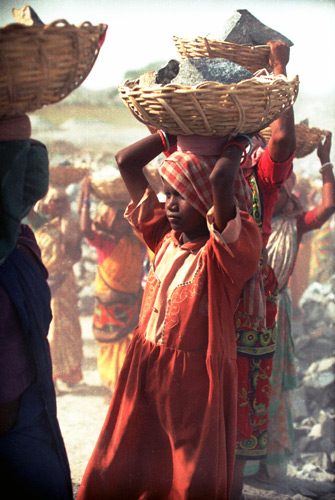
Above a five year old girl works brakeing stones, working to survive ... Child labour laws are routinely ignored in the rush for profits.

Huge sandstone quarries are fuelling landscaping boom on the cheap

In the blazing morning sun Naresh swings a hammer on to a square grey sandstone slab, his features focused on chipping away the rock until it is the length of his feet. Around the boy are crates of blocks, which are graded by texture and shape before being tied up into neat bundles.

What is harvested in this Indian quarry, in the heart of the largest sandstone reserve in the world, ends up laid on gardens in Britain.

Naresh wears no gloves, his feet are clad only in flip flops and his face is coated with a fine dust. The 12-year-old earns 70 rupees (82p) a day, less than 11p an hour, for 100 "gitti", about a square metre of paving stones that will cost £35 when sold for patios and driveways in Britain. He says that as long as he is paid, what the stones are used for and where they end up are not his concern. He works to survive. "My father is sick, my mother is dead. I make 2,000 rupees a month. I have to work. I do not want to go to school," he said in between thwacks of his hammer.

The child is part of a migrant workforce, drawn in by a sandstone rush in which more than 400,000 tonnes of rock will be mined in the next 12 months from the arid flatlands of the western Indian state of Rajasthan.

The supply may be in the subcontinent, but the demand is generated 5,000 miles away in the builders' yards and garden centres of Britain, where the rise of "landscape makeovers" has all but exhausted the paving stones traditionally mined from the Pennines.

Five years ago builders' merchants in Britain scoured the planet for rock whose colours matched the elusive York stone craved by garden-lovers in Britain. The closest match was the grey and beige sandstones from Rajasthan.

The result is a quarrying boom. Sandstone is desert India's version of oil, a mineral wealth just below the sands of Rajasthan that can be cut and mined cheaply and sold abroad for fat profits.

Illegal

The industry employs half a million people. More than a fifth are children who scuttle around mounds of rock in illegal mines with little more than a hammer and chisel. A host of international treaties and domestic laws prohibit child labour in India, but the authorities rarely enforce them.

The landscape in this part of the country is man-made. The rock has been scooped out leaving either veins of precious stone to be excavated by hand or hillock-sized slag heaps to be picked over by men, women and children.

Despite the flood of foreign money into the industry, the way Rajasthan stone is mined has changed little. Mines that have been emptied of their wealth are left to collect rainwater and rubbish.

Most of the work is still family-based, lacking the machines, tools and safety measures found in the west.
Experts say one death a day is not unusual in the mining business.

In another quarry, 35-year-old Kanta lifts heavy rocks while her six-year-old son sits on top of a pile of finished stone blocks keeping an eye on his 12-month-old brother. "My husband works [in a nearby mine]. I work here. Where will the children go? My eldest can play with the youngest here," she said.

The families come from tribal communities, who say traditional farming does not pay enough. The site foreman, who does not give his name, claims his workers will not wear the boots and gloves handed out by the mine owners. "They tell us it is too hot to work with these things," he said.

Workers have to pay to secure a job, which some experts say binds the workers to an employer. Kanta had to pay 2,000 rupees for her place in the quarry.

Last year a report to the Dutch parliament found problems relating to "bonded labour, child labour, hazardous and unfair working conditions and a series of environmental issues such as land degradation. [The] global natural stone trade has not yet taken up this challenge in any serious way".

There is also a growing awareness of the effect on global warming of shipping sandstone to the UK. Research shows that British reconstituted concrete has just half the carbon footprint of imported natural stone from India.

These findings are seeping into the buying public's mind. One of Britain's biggest building materials companies, Marshalls, says it became alarmed last year about the scale of the labour abuses uncovered by an internal audit. The company, which last year imported 2 million square metres of decorative paving from India, now buys only from one supplier in Rajasthan, which it has forced to submit to regular inspections and spend £350,000 mechanising production.

"We were frankly appalled by the scale of the child labour problem in Rajasthan. You could also see people on site without hard hats, no boots. Suppliers did not keep employment records. There were no first aid facilities.
It was a mess," said Chris Harrop, Marshalls group marketing director. "We insisted these things were put right because our customers are becoming aware of the ethics surrounding the debate. We even point people who want Indian sandstone to a company that will plant trees to reduce the impact on global warming of importing the stone."

Pressure

Many Indian organisations say foreign pressure is essential to change mindsets. "Child labour is a form of slavery which is allowed to exist because there is a lack of political will to do anything about it. We hope that like in other industries such as carpet-weaving that foreign buyers will change these practices in India," said Kailash Satyarthi, chairman of Bachpan Bachao Andolan, a group that works to end child labour.

However, many British companies say eradicating child labour is not a simple issue. The British Association of Landscaping Industries (Bali) said it had an "implied" policy on ethics and sustainability but that members had concerns over how far it should go in terms of child labour. Denise Eubanks, head of Bali's press department, said the instant abolition of such practices could replace "one evil [with a] potentially worse evil where children are forced into prostitution and other criminal activity to help support their families".

Paying the price

82
The daily wage in pence earned by Naresh, 12, for breaking up slabs
100
The number of "gitti" Naresh breaks up in a day, about one square metre
£35
The amount 100 gitti will fetch in a British garden centre
2000
The amount, in rupees, one worker paid to get a job (£23)
2000
The amount, in rupees, many workers earn in a month
400
Thousands of tonnes of rock mined in Rajasthan in a year

By Randeep Ramesh in Budhpura, Rajasthan

Source: The Guardian

Brick Kiln and Gravel Quarry Children West Bengal, India

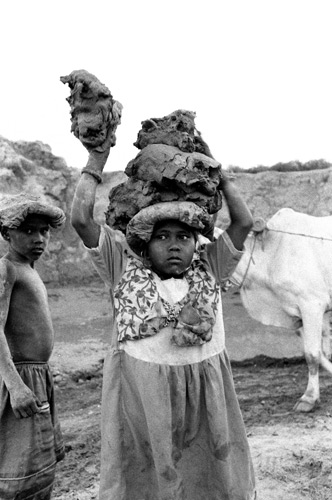
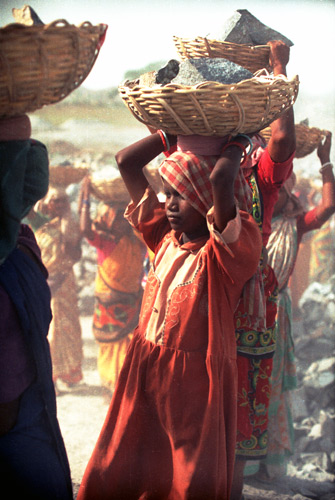
Left, West Bengal, India, Bonded (slave) child laborer carrying clay to the drying fields.

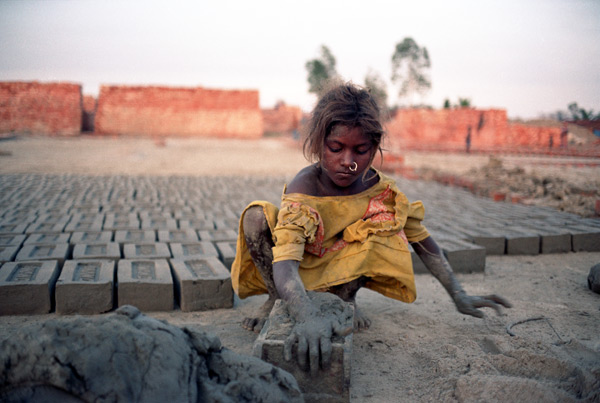
Brick kilns and gravel quarries are a common sight in West Bengal, Orissa and the surrounding states of India. The children that work here are exploited 12-16 hours a day, 7 days a week, 365 days a year. Their world consists only of these mud holes, drying fields, kilns, rock piles and grinders. At night they sleep in the open or in makeshift shelter where sanitary conditions are nonexistent. There are no schools here, and for many there isn’t even a family. Over 1/3 of the children working at this kiln and 1/4 of the children at the quarry have been shipped here from other areas, where their parents have been forced to either sell them into slavery or are dependent on the meager wages that these children can provide.

Above West Bengal, India 9-year-old bonded (slave) child laborer pulling excess clay from a brick form. The bricks behind her represent a day’s work.

Gravel Quarry

"The children in that quarry may be invisible in our ordinary life but they affect our life. I don’t think that any of us would feel comfortable being buried under a tombstone made by slave-child labor. But one of India’s biggest exports to the United States is tombstone marble. And it comes from quarries where children work."
- Pharis Harvey, International Labor Rights Fund

"I started working in a stone quarry when I was ten. A lot of children worked there and they would get hurt all the time. If we got hurt, they never gave us medicine."
- Kaushalya Kumari, age 15

India’s infant workers

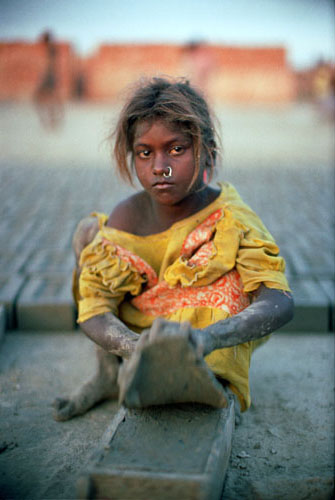
Above Girl, age 9, Brick Kiln, India - Child Slaves Owners prefer young girls as laborers because they're obedient.

Over here, sprouting up where once were matted lawns and soggy drives, are spanking new patios, apparently made of slabs of distinctive blue-grey York stone, yet costing only £35 per square metre.

Five thousand miles away, children as young as six hammer away at rocks in Rajasthan, India, to provide the blue-grey substitute that will be shipped to our garden centres.

We save a fortune - York stone is scarce and pricey - and they live short, brutal lives of overwork, undernourishment and loneliness.

As you would expect in a working environment so poorly regulated that tiny children are allowed to work long days for around 82 pence a day, there is no health and safety in the illegal quarries of Rajasthan, no hard hats or dust masks, no statutory breaks or subsidised meals, no rights, no work records, no first aid.

The workforce is mostly migrant labourers, up to a fifth of whom are children (under 14 in Indian law), who pick over the vast slag heaps, or dart down the dangerous, illegal mines with chisel and hammer, to work out the rock at a rate of 100 gitti (slabs) a day.

Babies and infants sit by while their parents and older siblings work.

Many are bonded labourers, who paid to secure a job, or whose parents were given a loan in exchange for their child’s labour.

These sums are not huge - often as little as 1000 rupees (around £10) - but the astronomical interest charged on them by employers, combined with wages that would make you weep, mean that they are never paid.

The debt lives on and endlessly on, passed down to younger siblings, back to parents, sometimes even onto the child labourer’s own children.The cycle of life is harsh, and brief.

Children who begin lives of hard labour at four and five, grow up - if such a term can be applied here - to be undernourished, chronically sick adults. Many don’t make it past 40.

Laws exist, a whole host of laws, dating back to the 1933 Child (Pledging of Labour) Act, but are rarely enforced and even when they are, and employers are convicted and charged, they receive only fines, and not particularly heavy ones.

According to Indian Census figures for the late 1990s, there were 12.05million children in child labour in India.

NGOs and other agencies say the figure is probably nearer 60 million, making India the world’s biggest employer of child labour.

These youngsters work in factories, restaurants, the home. Some 12 million are believed to be domestic servants, children employed - or rather, sold into bondage - to cook and wash and clean and even nanny their employer’s children, doing everything from nappy-changing to carrying their schoolbooks to the bus for them.Child labourers get no education, have no freedom, no contact with their families, and barely enough food to live on.

Being effectively invisible, they have no rights, and are frequently abused, mentally, physically, and sexually.

In 1996, the case of Arshad received international attention, thanks to the National Human Rights Commission taking up his case.

He was burnt on a stove and then branded with a hot iron by his master for drinking some leftover milk that his master’s son had left in a cup.

His master was a government employee, adding to the scandal.

Yet it took ten years for domestic labour to be included in the laws prohibiting the employment of children. And it continues.

Kailash Satyarthi, chair of Bachpan Bachao Andolan (BBA), says neither local nor national governments are bothered enough about child labour to do anything about itBBA is a grassroots organisation, founded in 1980, comprising over 780 NGOs, trade unions and human rights organisations, seeking to end child labour.They don’t just campaign, they organise and execute daring raids to physically release children from bondage and into rehabilitation programmes that enable them to learn vocational skills in an environment that nurtures rather than numbs them.

In 1999, they established a four-step strategy to ensure all children went to school, called the Child-Friendly Village or Bal Mitra Gram (BMG).

Step one of BMG is the withdrawal of all children from child labour to allow them step two, to enrol in school.

Achieving step one is no easy matter, not least because employers can be very aggressive when threatened with the loss of cheap labourBut the conditions exposed by these raids make it clear why such work is necessary.

On 6 June 2005, in the congested district of Raghunagar, Dabri in West Dehli, 29 children were released in a raid of a sari factory, following a plea from 8-year-old Waib Ansari, one of the child labourers incarcerated in this dreadful sweatshop.

The children, aged 7-12, were mostly trafficked from their home villages, their desperate parents having been conned into believing they would be educated and well-treated.

They weren’t. Rather, they worked a typical 9am - 3.30am day, six days a week, were kept locked up night and day, for 40 rupees (around 50 pence) a month.

Many had developed rashes and allergies as a result of chronic overcrowding

They were malnourished, and their vision was strained through endless close embroidery work. If they made mistakes, they were horribly thrashed.

Child labour is often justified as part of the natural way of things.

A justification only if you accept that abject poverty, so that other people can live lives of privilege and luxury, is also part of the natural way of things.

Child labourers, say the apologists, are suited to certain jobs, thanks to their ‘nimble fingers’ - a justification once used in the dark, satanic mills of Lancashire.

In fact, the really skilled work, for instance in carpet-weaving, is done by master weavers. Children are just cheap, and helpless.

BBA, when it releases children, provides them places in rehabilitation centres where they regain some sense of what it is to be a child, coupled with training in the work-skills that should enable them to live economically secure lives as adults.

The organisation works to create space for children to be heard in communities and families.Step three of the BMG is the formation of a children’s parliament, or panchayet, and step four, systems to ensure children’s voices are heard in adult panchayets.

They are mindful of the gender gap.

Two thirds of India’s child labourers are girls, so girls are given priority in elections for panchayet leaders, thus most are headed by female children.

There are also BBA campaigns for better schools, which see local villagers donating money and building materials to build the schoolhouses and provide the resources, including staff.

One such campaign in Ramchandranagar, 50km from Patna, saw a village where none of the 200 children had ever attended school transform into one where every child received a decent education.

And every July and August, there is a campaign to encourage children to go to school.

In 2003, some 20,000 children across seven states took part, and 9000 children, released child labourers, were enrolled in primary schools.

Government should provide, but doesn’t. Until its hand is forced, organisations like BBA must do the work, so that India’s poorest children don’t have to.

by Roz Paterson

Source: Scottish Socialist Voice

Monday, February 26, 2007

Emotions and Medication

Angie discusses growing up in foster care and being given medications in response to her emotions. Angie Cross travels around the US and helps to establish foster care alumni groups.

Source: psychtruth

Family Values - Rockridge Nation Video Series

Features George Lakoff deconstructing the conservative family world view.

George Lakoff examines progressive and conservative family values, and what they mean to American politics, in the second episode of the Rockridge Nation video series

Source: MadeGreenSF

Reviews: The Body Never Lies The Lingering Effects of Cruel Parenting

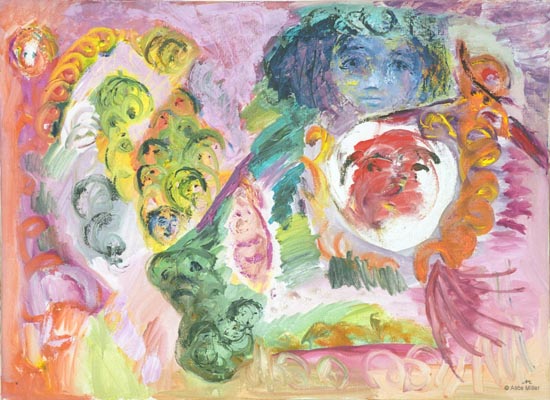
Above Oil Painting By Alice Miller
Reviews of Alice Millers Book: The Body Never Lies The Lingering Effects of Cruel Parenting by
Robin Grille
Stephen Khamsi

Norm Lee

Lucien X. Lombardo

Barbara Rogers

Promotional flyer by the publisher

Tiffany Fox
 
Robin Grille, psychologist, author of: Parenting for a Peaceful World
Few authors have championed the cause of the wounded child in all of us as Alice Miller has. In her latest masterpiece, The Body Never Lies, Miller's prose is, as ever, fearless and refreshingly direct. Miller breaks new ground as she tackles the most toxic cultural assumptions head-on, seeking to undo centuries of damage done to children by the most pervasive and most insidious of religious dogma. This book is as confronting as it is deeply liberating - it points the way to healing and greater love through uncompromising emotional honesty. Although this book is accessible and important for any reader, it is essential for counsellors and psychotherapists who wish to cultivate their capacity for true empathy.

Stephen Khamsi, Ph.D, May 11, 2005
Swords and Knives A review of Alice Miller's The Body Never Lies: The Lingering Effect of Cruel Parenting.

There is an unwritten law, an unacknowledged commandment, that adults may exploit children in extreme ways and in accordance with their needs and neuroses. There is, moreover, a social taboo against recognizing any of this. Parents are protected while children are sacrificed.
Tragically, much of psychology is comprised of nonsense and noise...rats, statistics, medications. So we are fortunate to receive the rare and exceptional work of Alice Miller. Her most recent volume, The Body Never Lies, continues one of psychology's most important collections. 

Dr. Miller's chief concern has always been childhood suffering, its denial, and the lasting effects on individuals and on societies. The focus of her current book? The denial of real emotions—the tension between what we really feel and what we "should" feel—and the enduring effects on the body. Real feelings are direct and visceral, and real feelings conflict with morality. The author's hope is to reduce personal suffering, isolation and tragedy. 

Our bodies, according to Miller, keep an exact record of everything we experience.

 Literally. In our cells. Our unconscious minds, moreover, register our complete biography. If emotional nourishment was absent during childhood, for example, our bodies will forever crave it. "Negative" emotions, to take another corporal example, are important signals emitted by the body. If ignored, the body will emit new and stronger signs and signals in an attempt to make itself heard. Eventually there is a rebellion. At this point, illness often results. The body is tenacious as it fights our denial of reality. 

Dr. Miller was moved to write this book after she heard about a mother who deliberately used medical preparations to provoke illness in her children, which ultimately resulted in death. This condition is known by the psychiatric community as Factitious Disorder by Proxy (FDP), and is more widely known as Munchausen Syndrome by Proxy (MBP). Most commonly, MBP is a pattern in which caretakers—usually mothers—deliberately induce physical problems in their preschool children, present their ailing offspring for medical attention, and then deny knowing anything about the cause of the child's malady. This is, of course, a most egregious example of an all-too-common betrayal. 

What betrayal? We know that child abuse and child neglect are pervasive and destructive. And we know that violence toward children is stored within them and, later in life, they will turn the violence on themselves—in depression, drug addiction, illness, suicide, or some other form of early death. And, according to Tears for Fears, "when life begins with needles and pins, it ends with swords and knives." Sometimes these swords and knives are directed at other people—sometimes at whole nations. 

In The Body Never Lies, Miller pays particular attention to the Fourth Commandment—the edict that one must honor one's parents, no matter their conduct. For thousands of years, this commandment—in concert with our personal denial of early maltreatment—has led us toward repression, emotional detachment, illness and suicide. This Commandment, suggests the author, is a species of morality "that consigns our genuine feelings and our own personal truth to an unmarked grave." While many of the Ten Commandments remain valid, the Fourth Commandment is diametrically opposed to the laws of psychology. 

To illustrate her ideas, Miller provides brief portrayals of Fyodor Dostoevsky, Anton Chekhov, Franz Kafka, Friedrich Nietzche, Friedrich von Schiller, Virginia Woolf, Arthur Rimbaud, Yukio Mishima, Marcel Proust, James Joyce, Saddam Hussein, and Adolf Hitler.
What do these writers, dictators, serial killers and others have in common? They all lived their lives in accord with the Fourth Commandment. They honored their parents, even though and even while their parents did them harm. Each individual sacrificed their truth in the unanswered hope that they would be loved, and each died in denial and isolation, tragically unable to admit to their own personal truths. These lives and these stories lend credence to Miller's argument that moral laws lead to repression and to emotional detachment. 

And what about these unlived emotions? Emotions have a basis in reality—they are reactions to neglect, abuse, or a lack of nourishing communications. "Negative emotions" are important signals emitted by the body in attempts to make itself heard. The banished emotions reassert themselves—real needs and feelings make their return to the body.
Sadly, many of us were unloved, neglected and abused. The remedy? While there are no simple answers, we do know that the body is healed when one admits to personal truths and to real feelings. But how do we admit to such truths and to such feelings? We need to feel our pain and our powerlessness so that we can, paradoxically, become less pained and more powerful. We need to admit to our "negative" emotions and change them into meaningful feelings. And we need to see through poisonous pedagogy in order to embrace and to embody integrity, awareness, responsibility, and loyalty to oneself. Our greatest personal task is to learn the difference between love and attachment...to extend our love when it's right, but to break off attachments when they are destructive. Our greatest therapeutic task is to locate an enlightened witness—a mature and helpful individual, who can be fully present without judging, is indispensable in this process of psychological integration and personal liberation. 

Techniques of converting "negative" emotions into "positive" emotions will fail. Why? 
Because these manipulations reinforce denial, rather than leading to honest confrontations with one's authentic emotions. And forgiveness, Miller reminds us, has never had a healing effect. Preaching forgiveness is hypocritical, futile, and actively harmful. Harmful because the body doesn't understand moral precepts. One may rightly forgive their parents if they realize what they've done, though, if they apologize for the pain they've caused. 

Still, Miller retains a hopeful view of the future. While society at present always sides with the parents, individual bodies are fighting against the lies. It's possible that our collective body may rise up and lead to a future society built on conscious awareness. First, though, we must jettison our "fundamentalist faith" in genetics and, I would add, pharmaceutical "miracles." With the help of a witness, each damaged individual needs to move through infantile fears and reject the illusion that our parents will save us. When we finally experience our real truths of being unloved, neglected and beaten; when we internally separate from our parents; when we experience love for the worthy child we once were...only then our bodies can experience rest and relief, and only then can we get on with the important business of real life. 

Stephen Khamsi, Ph.D., is a psychotherapist in private practice in San Francisco.
Norm Lee, May 2, 2005 Of Moms and Moses A Review of Alice Miller's book, THE BODY NEVER LIES: The Lingering Effects of Cruel Parenting

For I would prefer to have these [asthma] attacks and please you, rather than displease you and not have them.—Marcel Proust, in a letter to his mother

In his 1941 book "Generation of Vipers", Philip Wylie highlighted how slavishly this culture worships motherhood, scorned how soldiers spelled out "MOM" on parade grounds, and coined the term "momism". The book enraged many, but shook too few awake. Today, Alice Miller would show us, in detail, how those soldiers - and most of the rest of us - were, and are still craving the approval, affection and love denied us by our parents in our childhood. We are still caught in the illusion that we can somehow win and/or earn the love from the source that so long withheld it from us. 

We have to break free of our (internalized) parents' grip on us, that of the biblical injunction, "Honor (obey, worship,) thy father and thy mother." Until then we, in a sense, feel and behave and think like the little children we once were; we cannot grow up. Worse, because as children we weren't accepted and loved for who we were, parents repeatedly punished us in attempts to force us into the imaginary mold they had prepared for us, i.e., what a child should be. Dr. Miller's message is that our bodies bear a detailed record of every childhood hurt and humiliation inflicted, every spank and slap, insult and indignity. And until or if those internal, psychic wounds remain unhealed, we can expect to continue to pay the terrible price in physical illnesses. Powerless to do otherwise, we suppressed our true and good authentic selves to win the love our emotional survival depended on. 

Dr. Miller writes with astonishing and penetrating truth about the connections between childhood suffering at the hands of parents, and the physical consequences of obedience to the Fourth Commandment. The Biblical law, "Honor thy father and thy mother" is here challenged as the source of widespread - even universal - life-long suffering. As children we attempted to free ourselves from our feelings of fear, insecurity and confusion thru repression and dissociation/self-alienation. Whatever the cost (abandonment of our true selves), we persisted in loving and trusting our parents (we hardly had a choice) and strived to earn their approval, (and (thus) to please the Greater Parent in the Sky.)
Today, what stands between our bodies and the healing of those injuries is the hold the Fourth Commandment has on our minds. As we lie and breathe, the fear of parental rejection/punishment lurks within that fear. It has to be brought to consciousness and examined before healing can take place. We walk carrying a sack full of personal history, the burden of wounds inflicted by all the punishment and indignities that have ever happened to us. Until we heal those internal wounds, we daily pay a terrible price in suffering, much of it physical illness, and make others pay as well. Those others are most often our own children. The claim so often heard, "I got spanked and I turned out OK," cannot be upheld when it is understood how the denial of physical and emotional injuries are connected to present illnesses. 

There are three sections to this book: first: illustrations from the lives of famous literary people; second, efforts made at overcoming traditional morality, i.e., effects of 4th Commandment; and third, an in-depth case study of truth suppression as manifested in anorexia. Alice Miller has expounded at length in earlier books about dictatorial megalomaniacs like Hitler and Stalin who directed their hate and violence toward others. In this book she shows how we direct ours toward ourselves. Examples are taken from the biographies of well-known people: Franz Kafka, Dostoevsky, Checkhov, Schiller, Rimbaud, Proust, Virginia Wolfe, James Joyce, et. al. Shown are the efforts of their respective parents to make them over into the child they wanted, and the consequences in the victims' lifelong illnesses and early deaths. 

Dr. Miller repeatedly emphasizes the tragic effects, in the form of physical ailments, of the body's life-long yearning for parental love and affection. She touches on the way this suppression is expressed in religion: the command to love God, on pain of punishment when we fail to do so; the absurdity of inventing a parent-like creator, perfect and omnipotent, who craves our love. It is an odd god, an immensely dependent god, a Big Daddy who, if given the love demanded, will reward with an eternity in blissful heaven. (And the teenage suicide bombers of the Middle East are promised the bonus of 72 virgins to sweeten the deal.) Inasmuch as the Great Father is not loved, even worshipped, the alternative is agonizing punishment from now to the "end" of eternity. We have to liberate ourselves from the propaganda imposed on us - and enforced on us on pain of punishment - by conventional morality. This book calls for a higher morality, as it applies to parenthood. We cannot truly love our parents, she asserts, until we are liberated from the infantile attachment, the idolatry, that trapped us in childhood. 

Dr. Miller wants the reader to understand and accept that parents who abused us do not deserve our love and honor, regardless of a Moses-imposed commandment to do so. As we all must know, love is one thing that cannot be enforced. Like Sgt. Joe Friday, the body, in its wisdom, rejects illusions. It accepts only the facts, as higher morality is inherent not in the mind, but in our bodies. She takes to task all those friends and relatives and preachers and therapists who say, "Forgive your mother, forgive your father; they did the best they knew how. She changed your diapers, he sacrificed for you, and above all they loved you." Miller will not hear it: forgiveness is a crock and a trap, laid to continue the dependency, and preserve the hope, that somehow, sometime, we will finally bask in the love that was so long ago denied us. Reading Alice is like hearing someone whisper, "I know the secret you are hiding in your past, the feelings of hurt and fright and shame and humiliation at the abusive treatment you suffered at the hands of your parents. And I'm asking you - urging you, challenging you - to come out of that dark closet and face up to it." 

In the valley where I live, the #1 fear at whatever age is parental punishment. And among adults, it's primary defense is Denial. Behind the denial of childhood mistreatment lies the fear of punishment, therefore acknowledgement or recognition of it in adulthood can approach terror. But the price for denial is paid in physical as well as mental illness. When aware of it we see it everywhere: the suffering in the bodies and minds of strangers and of those dear to us. But we must begin with ourselves, confronting the punishing parent within. 

Lucien X. Lombardo, May 3, 2005
Some observations of Alice Miller's The Body Never Lies
In The Body Never Lies Alice Miller continues her analysis of the links between our experiences in childhood and their impact and value in our lives as adults. In this book she courageously explores two themes central to our individual, relational and political health: the connections between our adult body, mind and spirit and childhood, and the religious and cultural prescription to love and forgive our childhood oppressors found in the Fourth Commandment's mandate to "Honor Thy Father and Thy Mother". 

I say Alice Miller is courageous because in this book she is willing to directly challenge the accepted wisdom of millennia based in our most cherished and powerful beliefs. By applying a child-centered perspective, Alice Miller's analysis of biographies and writings of well-known literary figures and everyday human experience unflinchingly turns our comfortable world on its head. In doing so, Miller provides a straightforward and powerful understanding of the transition from childhood to adulthood based in liberation psychology and authentic relationships centered on facing the emotional truth of childhood experiences. 

Alice Miller describes the behavioral and relational 'truth' of childhood experience, both positive and negative, that neuro-biology and research on impacts of exposure to violence in childhood and adult health are demonstrating is stored in the body, in the cells and the neurons and their connections. No matter how much we deny, redefine or push from our memories the hurtful and damaging feelings of powerlessness and diminished human dignity we experienced in childhood at the hands of adults, the body does not forget. No matter how much we let moral precepts or normative social expectations tell our minds otherwise, the body knows the truth and reacts. When the 'truth', the subjective feelings and emotions linked to our experience (as Alice Miller uses the word 'truth') is denied, the body rebels, and illness in our body and in our relationships develops. When the 'truth' of our experience is acknowledged, confronted unapologetically and in an authentic way, our body and our relationships gain new health. 

As always, Alice Miller's insights into the value and contribution of childhood experiences to our adult lives allow us to see where we previously were blinded, to hear where we were previously deaf, and to speak in voices that were previously silent.

What can we see when we learn that childhood experience stored in the body? We can see our adult health in the liberated and free expression of empowering love experienced in childhood. We can see bodily and relational illness as a reflection of the battle for the authentic self to escape from the oppression of the mandate to honor and love those who have hurt us. 

What can we hear when we listen to the voice of childhood experience and its power in our adult lives? After reading The Body Never Lies we can, if we are fortunate to have positive enlightened witnesses direct their words to us, hear voices that confirmed our individuality and human dignity in our childhoods, voices that recognized our authentic selves and our subjective, emotional, experience based 'truths', and permitted us to express those truths in our bodily health and relationships. 

All too many of us, however, can also hear those voices that forced us to silence our authentic selves and to belittle, deny and repress our 'truths'. Confronting the power of 'poisonous pedagogy', we hear those voices that drained the 'truth' of our feelings and emotions into their wills and wishes. We hear the voices of those who transformed our feelings of hurt and powerlessness, our truths, into the love and honor that our social and religious principles mandate we give our parents. 

In our bodies and the voice of our bodies the reality of physical, emotional and sexual abuse and neglect is stored. We cannot escape it, even when we become adults. When we do not hear the voice of this childhood truth, we struggle in inauthentic relationships and ill health as adults. Often, we pass such problems on to another generation. Alice Miller opens our ears to these abusive voices so that we can challenge them with the voices of our truth.
What does Alice Miller help us to say and do? The Body Never Lies empowers us to speak 'our truth'. We must feel and act on an understanding that we need to be and can be 'enlightened witnesses' to others and ourselves. Forgiving those who do not recognize the harm they caused us does not cleanse the body, because the 'truth' of the hurt remains unacknowledged. The lie of forgiveness remains in the body. 

Alice Miller helps us to see the power and freedom in authentic communication, the frank exchanges that we desire. This is something that the traditional morality of therapy, religion and parenting expectations often hide in the disguise of 'honor thy father and mother' even when they dishonor you, the child. Alice Miller gives us way of understanding and acting that permits us to unflinchingly remove the disguise.

Though Alice Miller does not directly do so, The Body Never Lies offers us the possibility of rewriting the Forth Commandment from a Child-Centered Perspective. The new commandment would emphasize the parental duty to foster and respect the authentic personhood of children rather than the children's duty to submit to parental domination and personal self-denial. 

If God had understood how Moses felt about his abandonment, perhaps parents would have a duty to be 'enlightened witnesses' for their children. Perhaps if God had recognized that God had a childhood, and perhaps if God had created Adam and Eve as children instead of adults, if God set their goal as the expression of self-knowledge and watched their progress, instead of forbidding them knowledge, perhaps the Fourth Commandment passed to Moses would have read: 

Parents should honor and empower their children, so that they, their children and their children's children will live their own truths over long and authentic lives!
Then what would pass from generation to generation would be 'real love' and attachment based on the truth of experience rather than the façade of love based on guilt and attachment based on a morality of domination and control. Power would not mean, "to dominate and control", it would mean, "to empower". If we could apply to our own lives the understanding of the meaning of childhood experience that Alice Miller provides in The Body Never Lies, the personal, relational and political health of ourselves, our children, and all with whom we come in contact can be improved. 

Lucien X. Lombardo, Ph.D. is a Professor in the Department of Sociology and Criminal Justice at Old Dominion University.

Barbara Rogers, author of "Screams from Childhood

Alice Miller's "The Body Never Lies" is a provocation for those who are intent on denying that there is a relationship between how children are being treated and how they, later as adults, live their lives. They will fight against this book with those sad beliefs, which they learned in their childhoods and never questioned or left behind. But for those, for whom these connections are a fact and who are willing to explore their own past, their own lives and childhood suffering, this book provides great relief, even liberation.

On her life journey of research and writing, Alice Miller has gained great inner freedom and strength. In `The Body Never Lies', she courageously questions traditional morality and inspires us to face the often life long pain that children suffer through their parents. Her profound insights into this vital relationship create a truthful vision of man and his coercion to be destructive and self-destructive. Her visionary humanity leads the way into a new era, where the source of needless human suffering is movingly and powerfully recognized.
Like in an invisible jail, the fourth commandment confines many people into untruthful relationships with their parents, from which they often suffer. Abused and disrespected in childhood, they strive, still during their adult lives, to reach and even please cruel parents, who do not wish to understand and support them, who do not care about their well-being.
As long as they are under the spell of this commandment, they also often suffer in similar ways in other close relationships, denying their truth and reality like they had to as children with their parents. But there is a powerful witness to the suffering we endure through hypocritical, painful relationships—our body. Although we are trained to follow those moralistic expectations to honor our parents, no matter how they have treated us as children or treat us now as adults—the body refuses to do so. Again and again, it tries to communicate the tragic experiences that we carry hidden inside, in the unconscious. Alice Miller invites us to listen to and understand our bodies and ourselves with love by moving away from the destructive commandment that we must honor those who cause us harm and hurt us.

Promotional Flyer, by the publisher
"Alice Miller's arguments are lucid, closely reasoned, and utterly convincing."-Elaine Kendall, Los Angeles Times Book Review 

"Alice Miller makes chillingly clear to the many what has been recognized only by the few: the extraordinary pain and psychological suffering inflicted on children under the guise of conventional childrearing."-Maurice Sendak, author of "Where the Wild Things Are"
"As Alice Miller knows and makes so clear, the body remembers all the pain and suffering of childhood. Readers will find much in this book that resonates with their own experiences and learn how to confront the overt and covert traumas of their own childhoods." Philip Greven, professor emeritus, Rutgers University and author of Spare the Child: The Religious Roots of Punishment and the Psychological Impact of Physical Abuse

"In her brilliant book, Alice Miller uses famous people's lives, like Marcel Proust and Virginia Woolf, to teach us all a concept that is common in all of our lives—that unhealed trauma creates illness. I loved this book." -Mona Lisa Schulz, M.D., Ph.D., author of The New Feminine Brain and Awakening Intuition

BOOK NEWSW. W. NORTON & COMPANY, INC. A Promotional Flier from the Publisher
Since her revolutionary break with the study of child trauma on the adult person in the late 1970s, explicated in such groundbreaking works as The Drama of the Gifted Child, Prisoners of Childhood, and The Truth Will Set You Free, Alice Miller has stood at the forefront of psychotherapy's research into the legacy of childhood trauma on adult behavior. Her fascinating, deeply compassionate books offer case studies of both ordinary individuals and accomplished geniuses in order to examine the effects of cruel parenting on an individual's long-term happiness. THE BODY NEVER LIES [W. W. NORTON; MAY 23,2005; $23.95] is Miller's most lucid and compelling work to date, providing extensive evidence that only by acknowledging the wrongs done to us as innocent children can we move toward living as fulfilled and healthy adults. To do otherwise — to ignore the truth in order to protect our families and conform to society's norms — wrecks not just the soul but the physical body itself. 

Our daily responses to the world may be divided into the physical and emotional, yet these two categories are not autonomous. Our health is frequently damaged by long repressed feelings of emotional trauma, anger about being spanked or otherwise, these are hurts that we may have never consciously processed because to do so might break social mores. Over the decades since childhood, feelings of humiliation, rage, and powerlessness can fester if we insist on remembering a happy upbringing; untreated, these feelings will eventually manifest themselves in fatal illness. Such was the case, Miller shows, with such filially pious and brilliant authors as Arthur Rimbaud, Virginia Woolf, and Marcel Proust. Rimbaud's suffering under a malevolent and unsupportive mother drove him to the drug addiction, restless traveling, and bottomless self-loathing that finally caused him to give up writing and turn to business; he died at thirty-seven of cancer. Wolf committed suicide after accepting that her step-brothers' childhood molestation of her was her fault — the result of her own sexual fantasies according to Freudian theory. A suffocating mother kept Proust from publishing his masterwork In Search of Lost Time until after her death, for fear its incisive indictment of bourgeois values would offend her; an asthma victim since childhood, he died just two months after its publication. 

All of these authors died too young, refusing to acknowledge that their feelings of resentment toward their parents were legitimate, that society's embrace of the fourth commandment — "Honor thy father and thy mother" — might be fallible, even wrong. Miller goes on to consider the commonplace manifestations of childhood trauma in contemporary society, from substance abuse to anorexia nervosa. Most urgently, she presses us to seek understanding, nonjudgmental therapeutic treatment, lest we, too, inflict the crimes of our elders on future generations. 

THE BODY NEVER LIES is a book of healing, and its message continues the important research that earned Miller worldwide fame in her best-selling original work, The Drama of the Gifted Child. In all her writing, Miller proves herself a courageous, pioneering mind in exploring the most taboo of psychological subjects — cruel parenting. Her work is remarkable for its brilliant insight into the psychology of some of the greatest thinkers of Western history and its intimate portrayal of more ordinary individuals' long-term damage from child abuse, from her patients' to her own. Offering systemic analysis of how to approach therapy and live outside the traditions of a society governed by the fourth commandment, THE BODY NEVER LIES is necessary reading for all individuals committed to leading an enlightened and compassionate existence.

Tiffany Fox, amazon review, March 17, 2006

This book changed my life

After coasting through the past ten years in a fog of depression, emptiness, and unfulfilling relationships, I started seeing a counselor who recommended this book to me. I'm not exaggerating when I say it changed my life. Ever since I can remember, I have idealized my parents and my childhood, never realizing the myriad subtle ways that my narcissistic parent denied me expression of my true feelings and my real self. Storing up all those feelings ever since infancy, in an effort to win the parent's love and protect them from one's true self, has a poisonous effect on the body and the mind. As much as we try to hide those true feelings, they make themselves known through various kinds of suffering, both emotional and physical. This is the premise of Miller's book. 

Once we are allowed to give voice to those true feelings, and offer some attention and compassion to our real self - rather than the facade we have created to please others, namely our parents - then that self no longer has to cry for attention through the suffering of our bodies and minds. A whole new world of experience, expression, and life has opened up to me now that I have been able to acknowledge all the rage, grief, desperation, and need to be heard that I was never able to articulate before. Now I can be unafraid to be myself, and feel my feelings good and bad, without fear of abandonment. I highly recommend this book and Miller's other offerings to anyone dealing with depression, difficulty communicating to others, or feelings of emptiness and dissatisfaction in their life.
© 2006 Alice Miller

Resolving the Effects of Child Mistreatment

Do schools today kill creativity? TEDTalks: Sir Ken Robinson Video

Sir Ken Robinson is author of Out of Our Minds: Learning to be Creative, and a leading expert on innovation and human resources. In this talk, he makes an entertaining (and profoundly moving) case for creating an education system that nurtures creativity, rather than undermining it.


February, 2006 at the TED conference in Monterey, CA.


Suicidal girls calling for help

One in six calls to a 24-hour helpline last year concerning mental health came from girls contemplating suicide.

Some rang ChildLine while attempting to kill themselves, while others had tried to take their own life, and were thinking of doing so again.

In total, more than 6,000 children and young people - some as young as five - called the helpline about mental health problems, ChildLine analysis found.

Problems included depression, eating disorders, bullying and sexual abuse.

On one occasion a ChildLine counsellor helped save the life of a girl who had taken an overdose in her bedroom while her parents were downstairs, unaware of what was happening.

After getting the girl's agreement, the counsellor called the emergency services and an ambulance arrived at the house in time to save the youngster whose grateful father rang the next day to say thank you.

Research suggests rates of depression and anxiety have increased among adolescents in the UK by 70% in the last 25 years.


Crisis point

Joelle Leader, assistant director of ChildLine, said: "When young people talk about suicide they are obviously in deep despair.

"They are at crisis point with no one else to turn to, which is why they call us.

"The number of children who rang to talk about mental health issues last year could have filled 250 classrooms, so it's a big problem."

Ms Leader said ChildLine could offer immediate support and advice, but it was clear that many young people needed more intensive therapeutic support over a sustained period.

"At the moment, there are simply not enough therapeutic services for children with these problems, and we are urging the government to give this issue urgent attention."

Of the calls to ChildLine about suicide (1,265) nearly four out of five came from girls.

However, in the 15 to 21 age group suicide is three times more common among boys.

Eating problems also featured high on the list of mental health concerns, with 1,854 girls and 158 boys ringing for help and advice.


Source: BBC
Watch the Childhline ad: We Hear Scared Pleople
Childline
NSPCC

Sunday, February 25, 2007

Unhappy families

"All happy families are alike; each unhappy family is unhappy in its own way" -

from Anna Karenina by Leo Tolstoy

WHEN Karen Greechan's second son, Ryan, was born, she admits she was completely overwhelmed. "He was a totally different character from my first son, Conor," she says. "He had no patience and was incredibly independent. Where Conor would sit on my knee and listen to a story, he couldn't stay still for 10 seconds. He didn't sleep and demanded attention constantly, so Conor was getting ignored."

Having worked as a receptionist, Karen, whose husband often works nights, now found herself at home with her children 24 hours a day. Her relationship with Ryan, now four, was suffering, she was shouting all the time and Conor, now seven, was being ignored. "None of the techniques I had used with Conor worked with Ryan," she recalls. "I was sleep-deprived and depressed."

It's a scenario familiar to all those who struggle with the demands of family life, especially parents who have to balance them with other pressures, such as work, or the strains felt by the growing band of single parents. Then there are those who must contend with teenagers who swing from being the bright young person they always wanted them to be into sullen strangers.

The question is, to whom should parents turn at such times of stress? Sociologists say the decline of the extended family has made sources of advice harder to reach; professional advice is available, but few of us know how to get it, or if it will cost us money. And then there are the cultural obstacles: isn't turning to outsiders a sign of weakness and of parental failure?

After her experience, Karen has no such qualms. A chance meeting with someone who works for Children 1st led her onto a 12-week parenting course, which taught her new ways to communicate with her son. "They showed me how to ignore bad behaviour and reward positive behaviour. We had a star chart and, when he realised I would follow through, his behaviour and sleeping began to get better. Now the traits I saw as negatives have become positives. It is great he can do so much for himself. Of course, he still likes to get attention, but he knows Conor has to get some too."

But Karen was one of the lucky few, according to a survey conducted by Parents Across Scotland (PAS). It found most families feel under similar pressure but have nowhere to turn. The charity will present its full findings to the Scottish Parliament on Tuesday, when it will ask for more help to be made available.
What emerges strongly from the poll of 1,250 parents from across the social spectrum is that they are more worried than ever about bringing up their own children.

PAS coordinator Maddy Halliday says: "We are reaping what we have sown in terms of decades of underinvestment in youth services in the UK. We have been slow to support family development whereas other European nations have invested in their children. You only have to look at the provision of things like playing fields and youth clubs. They are not at the top of the priority list. Kids are more frustrated and parents feel more isolated than ever before in trying to deal with them.

"All parents have difficulties, with parents of young teenagers finding that even normal teenage behaviour can be extremely difficult. But what they are saying very consistently is that they are getting very little support. Being a parent is an interesting and challenging job but society tends to take it for granted."

According to the PAS survey, those seeking counselling services - 5% - are still in a tiny minority, but almost 80% would now actively consider it. Halliday detects a huge "cultural shift" taking place.

"People have traditionally felt very uncomfortable about seeking help for parenting problems," she says. "Those who use counselling services constantly praise them. There seems to be huge demand out there and if more people are going to start coming forward then we must make sure that the services are there to help them."

The survey's findings have come at a time when a series of other reports and incidents have created a picture of many British families in crisis, with parents often feeling under pressure and out of their depth.

Earlier this month, the UK found itself at the bottom of a Unicef league table charting the physical and emotional wellbeing of children in 25 industrialised countries. Only the US had more children living in households where the income was less than the national average. British children drank more alcohol than any others in the report and had the third highest rate of teenage pregnancy.

Girls as young as five are also being psychologically damaged by attempts to sexualise them, according to the American Psychological Association, which blames inappropriate clothing, toys and images in the media for corrupting childhood.

Meanwhile, at the extreme end of the spectrum, the teenage sons of black families in London have died in a series of apparently gang-related shootings.

Maggie Mellon, chairwoman of PAS, says: "I think there are more stresses on the family today. They are more likely to have both parents working and one parent living away from home. Life is lived at a faster pace and parents are told everything is their responsibility.

"They worry about obesity, education, disorder. Where they used to play out on the street, that's frowned upon now, so parents feel they have to keep children in. Then there's exams and careers and alcohol and drug abuse to worry about. And people no longer live in extended families, so when trouble does flare up there's no one to turn to."

Although parenting workshops can be accessed through organisations such as ParentLine Scotland (run by Children 1st) PAS and local authorities, and family therapy through health visitors and GPs, provision is patchy.

Where such services are available, users say they are effective. Carolann and Ally Banks knew they needed outside help when their teenage son started lashing out at the rest of his family. Frustrated by learning difficulties, Jonathan, now 16, often became difficult to restrain as he experienced terrifying explosions of anger.

With his sister Katie, 14, also demanding attention, the whole family reached boiling point. "There were constant outbursts and screaming as Jonathan and Katie fought with each other," says Carolann, a former nurse, who lives in Edinburgh. "We got to the stage that we were desperate."

That was almost year ago. But, just as things hit rock bottom, the family were put in touch with the Amber project, a mediation service for families with 16 to 24-year-olds who are finding life at home difficult.
There, mediators talked to the family members, individually and then all together, so they could discuss their different needs before drawing up a contract.

"I have learned now how to walk away from the temper tantrums, to give them 15 minutes to calm down before trying to find out what triggered them," said Carolann. "It's really hard, but I know now not to shout back but to talk softly, in a whisper even, so they have to stop screaming to hear what I'm saying, and things have improved."

Professor Lynn Jamieson, co-director of the Centre for Research on Families and Relationships at Edinburgh University, believes parents' willingness to seek outside support may be influenced by reality programmes such as Supernanny, which show how professionals can help deal with tricky situations. But she adds: "Although parents are saying they would be willing to consider counselling, not many of them have actually accessed it, which suggests to me there may still be some stigma attached to the idea of looking for help."
Jamieson believes the pressures on parents today are different, although not necessarily greater than those on previous generations. "With a high proportion of mothers acting as providers, parents do feel more time-pressured. And we have such a high standard of living, our expectations of what we should achieve are raised. Where once if your children were well-fed, clean and well-clothed, you were doing okay, now parents feel they should be enriching their children's lives in other ways."

She believes groups where parents get together to pool their parenting tips can provide the most effective support where resources for counselling are lacking.

Others warn against a one-solution-fixes-all approach, however. They stress the need to customise the way we treat youngsters according to their individual needs - and that their parents are best placed to identify and react to them, not outsiders.

Nick Seaton, chairman of pressure group Campaign for Real Education, believes parents are having their confidence shaken by the kind of TV programmes identified by Jamieson. "These programmes suggest all parents should think along the same lines and those are not necessarily the best lines. Ideally, parents should work these things out for themselves. Every family has a different set of circumstances so different approaches will suit them. It is much better that people tailor their behaviour to their individual circumstances than that they take on parenting styles that don't work for them because they are made to feel they are better.

"Of course, parenting workshops and family therapy may benefit a few people, but others, who are doing a good job, may become alarmed by them and start thinking they have been doing things wrong. I think the vast majority of parents understand very well how to bring up their children."

Maureen Watt, an SNP MSP in the north-east, is one of five politicians who have agreed to speak at a special meeting at the parliament this week to discuss the findings of the PAS survey and look at how resources can be improved.

As a mother of two teenagers - Stuart, 15, and Kirsty, 14 - she is well aware of how demanding parenting can be. "People shouldn't think it is an easy job. It's very challenging and there's no real training other than how your parents brought you up," she says.

Her solution? "I think the key is to keep the channels of communication open and never to stop giving them hugs."

By DANI GARAVELLI AND JEREMY WATSON

Source: Scotland on Sunday

Comment: I attend Family Therapy at Couple Counselling Lothian this service has been invauluable to my in my emotional healing and helping me heal my childhood traumas. So Big thanks to Nick and Sue from Family Therapy at Couple Couselling in Edinburgh. :)

Children 'harmed by starting school aged four'

The long-term development of the majority of children is being harmed by them being forced to start school aged four, according to a study.

Parents are coming under increasing pressure to enrol children early to make sure they get a place in the best schools, fuelling anxiety levels and damaging youngsters' self-esteem, it is claimed.

Latest Government figures show that almost 800,000 children in primary schools are aged four or younger, with around 80 per cent now entering before their fifth birthday.

The shift is being blamed on schools which advise families to start children as early as possible to maximise Government funding.

Experts warned last night that the development risked damaging a generation of children who are "not being allowed to grow up". It comes a week after Britain's children were branded the unhappiest in the West by a Unicef study.

Margaret Morrissey, of the National Confederation of Parent Teacher Associations, said: "Many small children aged four are barely out of their push chair when they are suddenly going to school. We have been assured that schooling at that age is informal and all about learning through play, but that is simply not the case.

"Thanks to inspectors, tests and league tables lessons even for four-year-olds are becoming very rigid.

Children can no longer wander off and doze on a bean-bag if they are tired – they are being pushed by an increasingly demanding curriculum."

The legal starting age for children is five. In the past, many parents could send them to school at three different points during the optional reception year, with many waiting until they were five or close to their birthday.

But a study by the Times Educational Supplement shows most schools now only admit children in September to maximise Government grants. If a pupil starts in January or April schools do not get funding for them.

According to the study, matters have got worse under Labour, with hundreds of schools denying parents the chance to choose to enrol children later in the year. An influential study by the National Foundation for Educational Research found that an early introduction to school can "increase anxiety and have a negative impact on children's self-esteem and motivation to learn".

Another study of 1,400 children in Glasgow found that boys who started at four-and-a-half were still at a disadvantage when they reached secondary school. Britain is almost alone in Europe for having a compulsory school age of five, let alone four. Most countries do not start children until six. And in most European countries, there is a strong kindergarten or nursery system where children learn in an informal atmosphere of play.

Mick Brookes, of the National Association of Head Teachers, said: "Why are we going increasingly against the trend which works so well on the continent? Most countries start compulsory schooling later than us yet by the age of 11 their children have overtaken ours."

A Education Department spokesman said: "Children do not have to start school until they are five though most areas offer admission to reception at four.

"Where children are not yet five, we encourage schools and local authorities to allow parents to defer their child's entry to a later point in the academic year, for example January or April."

By Graeme Paton

Source: The Telegraph

British youngsters get worst deal, says UN

Disaffected British youth: Unicef says youngsters are better offoverall in every other industrialised country included in their report

Britain has been ranked bottom out of 21 countries in a United Nations assessment of children's well-being.

The nation's high number of single parents and step-families has contributed to the ranking.

The scathing report by the UN children's fund, Unicef, says youngsters are better off overall in every other industrialised country, including less wealthy nations such as Poland and the Czech Republic.

It says there is statistical evidence to link growing up in single-parent families and step-families with a greater risk of dropping out of school, leaving home early, poorer health, low skills, and low pay.

Of 7.3 million families with parents of working age in Britain, a quarter are lone parents. The nation has far more single-parent families than any other EU nation.

It is predicted that by 2010 there will be more children living in a step-family than in their biological family.

According to today's report, the UK lags in other areas too such as the number of children living in relative poverty, vaccination rates, and the time spent talking, or eating with a parent or parents.

It also has high rates of obesity, drunkenness, bullying, early sexual intercourse, cannabis-taking and teenage pregnancy.

Britain was rated higher for education, but languished in the bottom third for each of the other measures, giving it an overall placing at the bottom, along with the US.

The report was published by the fund's Florence-based Innocenti Research Centre before a national inquiry into the state of childhood, chaired by the Government's unofficial "happiness" tsar Lord Layard.

Drawing on 40 separate indicators, it attempts to measure and compare child well-being in six areas: material well-being, health and safety, education, peer and family relationships, behaviours and risks, and young people's own subjective sense of well-being. Bob Reitemeier, the chief executive of The Children's Society, a charity, said today: "We cannot ignore these shocking findings. Unicef's report is a wake-up call to the fact that, despite being a rich country, the UK is failing children and young people in a number of crucial ways."

Anastasia de Waal, the head of family and education at the think-tank Civitas, said: "That we rank so poorly as a rich welfare state is an indictment of Government policy. Underlying our poor record are serious social problems that New Labour isn't addressing."

Prof Sir Albert Aynsley-Green, the Children's Commissioner for England, said: "The findings are disheartening but not surprising as they echo what children tell me on a daily basis."

The shadow chancellor, George Osborne, said: "This report tells the truth about Gordon's Brown's Britain."

But the report is bound to be controversial because of some of the ways "well-being" is measured.

For example, the UK rates poorly on relative poverty because some incomes in Britain fall far below the incomes of others in the UK.

Likewise, well-being is measured in terms of how many children live with both parents.

Lone parent organisations argue that there is no evidence that all children with one parent are bound to turn out worse off in adult life than children of traditional family units.

Relationships

Top: Italy
Bottom: Britain

Overall, about 80 per cent of children in the countries under review live with both parents, from 90 per cent in Italy to less than 70 per cent in Britain. Fewer than 50 per cent of UK children say their peers are "kind and helpful" compared with 80 per cent in Portugal.

Behaviour

Top: Sweden
Bottom: Britain

Fewer than 15 per cent of young people report being drunk on two or more occasions. But in Britain this rises to almost a third. The number of young people who admitted using cannabis varied from five per cent in Sweden to more than 35 per cent in Britain, Canada and Switzerland.

Self-esteem

Top: Netherlands
Bottom: Britain

Children's sense of well-being — whether they were positive or negative about life — was higher in the Netherlands, Spain and Greece and lower in Poland and Britain. Girls reported lower levels of health than boys. This difference gradually increases with age.

By Sarah Womack

Source: The Telegraph