Friday, December 29, 2006

"The Body Never Lies": A Challenge

Click on the image above to find out more about

Alice Millers latest Book

Almost all my books have aroused conflicting responses. But the emotional intensity with which the statements I make in my latest book have been affirmed or rejected is remarkable indeed. The impression I have is that this intensity of feeling is an indirect expression of the extent to which the readers in question are close to, or remote from, their own selves.

After the publication of the original German version of The Body Never Lies in March 2004, many readers wrote to me saying how relieved they were that they no longer had to feign feelings they did not really have, or to deny feelings that kept on reasserting themselves. But in other responses, notably in the press, I have found indications of a fundamental misunderstanding that I myself may have contributed to by using the word "mistreatment" in a much broader sense than is usually the case.The image this word typically conjures up in our minds is that of a child whose whole body displays the tokens of the physical injuries he or she has been subjected to. But what I call "mistreatment" in my latest book has much more to do with violations of the child's mental or psychical integrity. Initially those violations remain INVISIBLE. The consequences frequently appear decades later, and even then it is rare for the connections with the injuries suffered in childhood to be recognized and taken seriously. Both the victims themselves and society in general (physicians, lawyers, teachers, and unfortunately many therapists) prefer to close their eyes to the fact that the real causes of later "disorders" or "misguided behavior" are very often to be found in childhood.

My decision to call these invisible injuries "mis-treatment" sometimes arouses resistance and indignant protest. I find this attitude easy to understand because it is one that I shared for a very long time. Earlier, if someone had suggested that I had been cruelly treated as a child, I would have roundly denied the "insinuation". But today I know quite definitely that in my childhood I was indeed exposed to mental cruelty for many years. My dreams, my painting, and not least the messages of my own body have told me this, but as an adult I refused to accept the fact for a very long time. Like many other people I thought: " Me? I was never beaten. The few slaps I got were nothing special. And my mother took so much trouble with me." (In my book the reader will find similar statements by others).

But we must not forget that the consequences of early, invisible injuries are so severe precisely because they derive from the trivialization of childhood suffering and the denial of its importance. Adults can easily imagine that they would be horrified and humiliated if they were suddenly attacked by a raging giant many times bigger than themselves. Yet we assume that small children will not react in the same way, although we have all kinds of evidence to indicate how sensitively and competently children respond to their environment (cf. Martin Dornes: Der kompetente Säugling; Jesper Juul: Your Competent Child). Parents believe that slaps and spanking do not hurt. Such treatment is designed to impress certain values on their children. And the children end up believing that themselves. Some even learn to laugh the whole thing off and to deride the pain they felt at the humiliations inflicted on them. As adults they adhere to this derision, they are proud of their own cynicism, sometimes even making literature out of it, as in the case of James Joyce, Frank McCourt, and many others. If they are assailed by symptoms like anxiety and depression, the unavoidable results of the repression of their genuine feelings, then they will easily find doctors who can give them medication that will help, for a while at least. In this way they can maintain their self-irony, that tried and trusted remedy against the feelings asserting themselves from the past. And in so doing they comply with the demands of a society that attaches supreme importance to considerate treatment for parents.

A woman therapist who read my last book very thoroughly and understood what it has to say told me that she has now taken a more forthright line in indicating to her clients the injuries inflicted on them by their parents. In almost all cases their response has been to resist the very idea. She asked me whether the Fourth Commandment is an adequate explanation of this obstinate attachment to their idealized parents.

My conviction is that, while the Fourth Commandment only really takes effect with older children, the reasons underlying the clients' almost limitless tolerance of the treatment meted out to them by their parents (so limitless that outsiders sometimes find it hard to credit) goes back to a very much earlier stage in their development. Even very small children learn to deny the pain that their parents are so completely unaware of ("a slap doesn't hurt"), to be ashamed of it, to blame themselves for it, or to deride it, as I mentioned above. At a later stage these victims cannot allow themselves to acknowledge that they were in fact victims. Thus in therapy the clients are unable to identify the true culprit. Even if they do experience a resurgence of their suppressed emotions, the truth will have a hard time asserting itself against the mechanisms internalized at such an early stage. After all, those mechanisms have done such long and sterling service in playing down the pain and apparently banishing it altogether. Relinquishing them means swimming against the tide, and that is not only frightening but initially arouses feelings of loneliness. It also exposes us to accusations of self-pity. Yet it is here that the path to genuine maturity, to the emotional honesty begins.

Many therapists - though I hope not all - are at pains to divert their clients' attention from their childhood. In this book I show very clearly how and why this happens, though I do not know what percentage of them do this kind of thing. There are, after all, no statistics on the issue. My descriptions will help readers decide whether the therapies they are undergoing are encouraging self-companionship or exacerbating self-alienation. Unfortunately the second of these two alternatives is frequently the case. In one of his books, an author highly regarded in analytic circles goes so far as to say that there is no such thing as the "true self" and that it is misleading to talk about it. With therapeutic care based on such an attitude, what chance would adult clients have of identifying their childhood reality? How could they gain awareness of the powerlessness they experienced as children? How could they relive the despair they felt when those injuries were inflicted on them, over and over again, year after year, without being able to perceive their real situation because there was no one there to help them see it? These children had to try to save themselves, by taking refuge in confusion and sometimes in self-derision. Adults unable to resolve this confusion at a later stage in a form of therapy that does not impede all access to the feelings will remain prisoners of the derision of their own destinies.

But if they do manage to use their present feelings as a key to their simple, justified, and strong emotions as small children and to understand them as comprehensible responses to the (intentional or unintentional) cruelties of their parents or stand-in parents, then they will have nothing more to laugh at. The derision, the cynicism, and the self-irony will disappear - and with them, usually at least, the symptoms that have been the price for this luxury. Then the true self, the authentic feelings and needs of the individual, will become accessible. Looking back on my own life, I am astonished at the single-mindedness, the endurance, and the implacability with which my true self has prevailed against all external and internal resistance. And it continues to prevail, without the help of therapists, because I have become its Enlightened Witness.

Naturally, eschewing cynicism and self-irony is not sufficient in itself to come to terms with the consequences of childhood cruelty. But it is a necessary, indeed an indispensable, precondition for doing so. With an attitude of persistent self-derision we could go through a whole series of therapies without any appreciable progress because we would still be cut off from our genuine feelings and hence from any empathy for the children we once were. What we (or our health insurance) then pay for is a species of therapeutic care that, if anything, helps us to flee from our own reality. And we can hardly expect any change for the better to come about on that basis.

Over 100 years ago Sigmund Freud subjected himself without reserve to the prevailing idea of morality by putting all the blame on the child and sparing the parents. His successors did precisely the same. In my last three books I have pointed out that while psychoanalysis has become less prone to close itself off from the facts on cruelty to children and sexual abuse and is indeed making an effort to integrate these facts into its theoretical considerations, these attempts are still largely thwarted by the Fourth Commandment. As before, the role of parents in the development of symptomatologies in children is still played down and actively misrepresented. I have no way of knowing whether this so-called broadening of horizons has really changed the attitudes of the majority of therapists. But the impression I get from publications is that reflection on traditional morality has yet to take place. The behavior of parents continues to be defended both in practice and in theory, as was brought home to me by Eli Zaretsky's book Secrets of the Soul (Knopf 2004) with its detailed history of psychoanalysis up to the present (and with no discussion of the Fourth Commandment). This is why my engagement with psychoanalysis is more marginal in The Body Never Lies.

Readers unfamiliar with my earlier books may find it difficult to recognize the huge difference between what I have written and the theories of psychoanalysis. After all, analysts focus their attention on childhood to a very large degree and are increasingly open to the idea that early traumas have an impact on later life. But the injuries inflicted by PARENTS are still frequently evaded. The traumas usually addressed are loss of the parents, severe illnesses, divorces, natural disasters, wars, and so forth. Here patients feel that they are no longer alone with these traumatic events. Analysts find it easy to empathize with their situation as children, and as Enlightened Witnesses they can provide effective aid in coming to terms with those childhood sufferings, not least because they rarely remind these analytic therapists of their own sufferings. But things are very different when it comes to the injuries that most people have been exposed to, when it comes to perceiving the hatred displayed by one's own parents and later the hostility of adults toward their children.

To my mind, Martin Dornes' interesting and enlightening book (Der kompetente Säugling, 1993/2004) shows clearly how difficult it is to reconcile the notions guiding most analysts with the latest research on infancy, although the author is greatly concerned to convince the reader of the opposite. There are many causes for this, and I have indicated them in my books. But I believe that the main reasons are to be found in the effects of thought blockades (cf. AM, The Truth Will Set You Free, pp. 115-145). Together with the Fourth Commandment, these barriers divert our attention from childhood reality. Sigmund Freud himself, and above all Melanie Klein, Otto Kernberg, their successors, and the ego-psychology of Heinz Hartmann have all ascribed to the child what was dictated to them by an upbringing in the spirit of Poisonous Pedagogy: children are evil by nature, or "polymorphically perverse." (In Banished Knowledge I have quoted an extensive passage by the highly respected analyst Glover on his view of children). All this has very little to do with childhood reality, and certainly with the reality of an injured and suffering child. And as long as corporal punishment and other forms of mental cruelty are almost universally considered to be a legitimate feature of "proper" upbringing, there can be no doubt that the majority of children come under this heading.

Other analysts like Ferenczi, Bowlby and Kohut, openly addressed this reality. The result was that they have remained on the margins of psychoanalysis because their research was in crass contradiction to the drive theory. Yet as far as I know, none of them left the International Psychoanalytical Association (IPA). Why? Because like so many others today, they all hoped that psychoanalysis was an open rather than a dogmatic system and that it would be in a position to integrate the findings of modern research. While I do not wish to say that this will never be the case, I do believe that the indispensable prerequisite for such an opening-up is the freedom to perceive the real mental injuries incurred in infancy ("cruelty") and to recognize the trivializing attitude of parents to the sufferings of their children. This will only be possible when work on the emotions finds its way into psychoanalytic practice, when there is no longer a fear of the revelatory power of the emotions. Such a development would by no means be necessarily identical with primal therapy. But psychoanalysis must recognize the revelatory power of emotions. Once this happens, the survivors can face up to their early injuries and carve out a path to their origins and true selves with the help of an Enlightened Witness and the messages from their own bodies. As far as I know, this has yet to take place in the framework of psychoanalysis.

In my book The Truth Will Set You Free (2001), I illustrate my criticism of psychoanalysis with reference to a concrete example (pp. 157-165). Here I was able to show that even the very creative analyst Winnicott, could not really help his colleague Harry Guntrip because he was unable to perceive or denied the hatred that Harry's mother had felt for her son. This example stronglypoints up the limitations of psychoanalysis, that protects the parents, and it was those limits that prompted me to leave the Psychoanalytic Association and go my own way. This got me branded as a heretic, what I undoubtlessly have been. Unpleasant as it is to be rejected and misunderstood, the situation of a heretic also brought me major benefits. It proved very fruitful for my research, as it gave me the freedom I needed to follow up the issues I really cared about. Suddenly all avenues were mine to explore, and no one could tell me what to think, or dictate what I was allowed to see and what problems I must on no account address. I relish this freedom of thought very much.

Thanks to this freedom I could afford to take an unsparing view of parents who ruin their children's lives. This meant violating a major taboo. Not only in psychoanalysis but also in society as a whole, such a step is still considered a scandal. "Parents" and "the family" must on no account be presented as a source of violence and suffering. The fear of this knowledge manifests itself quite obviously in most television programs on the subject of violence. (In the recent past I have expressed my views on these issues in various articles on my website).

Statistical surveys on cruelty to children and also the many clients who have reported on their childhood experiences in therapy have led to the establishment of new forms of therapy outside the domain of psychoanalysis. These concentrate on the treatment of trauma and are employed in many hospitals. But even in these forms of therapy (despite the best of intentions about providing empathic care for the patients) the individual's genuine feelings and the true nature of his/her parents can still be disguised, notably with the aid of imaginative and cognitive exercises or spiritual consolation. These so-called therapeutic interventions divert attention from the authentic feelings of clients and the reality of their childhood experiences. But clients require both access to their feelings and to their real experiences if they are to find the way to their own selves and thus dispel their depression. If this is not the case, some symptoms may disappear only to recur in the form of physical ailments as long as childhood reality is ignored. This reality can also be left out of account in body therapy, particularly if the therapist still fears his/her own parents and is thus forced to go on idealizing them.

We now have many reports in which mothers (and, in the ourchildhood forums on the Internet, also fathers) give honest accounts of how they have been prevented from loving their children as a result of the injuries inflicted on them in their own childhood. We can learn from them, and if we do, we will cease to idealize motherly love at all costs. Then we will no longer be forced to analyze infants as screaming monsters. Instead we will begin to understand their inner worlds, to grasp the loneliness and impotence of children growing up with parents that deny them any kind of loving communication because they themselves have never experienced it. Then we will recognize in the screams of the infant a logical and justified response to the usually unconscious but none the less factual and real cruelties of the parents, which have yet to be appreciated as such by society. An equally natural response is the despair of individuals about their damaged lives, a despair that some trauma therapies attempt to alleviate with the aid of "positive thinking". But it is precisely these strong "negative" emotions that enable us to recognize how we must have felt when we were ignored or treated cruelly by our parents. We absolutely need this recognition to eventually overcome the painful effects of the traumas.

Parental cruelty does not always take a physical form (though about 90% of the population of the world are beaten in childhood). It can manifest itself above all in the absence of kindness and communication, in oblivion to the needs of the child and its psychic torments, in senseless, perverse punishment, in sexual abuse, in the exploitation of the child's unconditional affection, in emotional blackmail, in the destruction of selfhood, and in countless variations in the exercise of power. The list is endless. And the worst thing is that children have to learn to see this as quite normal behavior because they know nothing else. Children always love their parents unstintingly, whatever they do to them.

In one of his books, ethologist Konrad Lorenz gives a very sensitive description of the love of one of his geese for a boot. This was the first thing the gosling had laid eyes on at birth. An attachment of this kind is instinctive. But if we humans were to follow this natural instinct all our lives (useful as it is at the outset), then we would remain well-behaved little children and never enjoy the benefits of adulthood. Among those benefits are awareness, freedom of thought, access to our own feelings, the ability to compare. The fact that churches and governments have a major interest in impeding this development and leaving individuals in dependency on parent figures is generally well-known. What is less well-known is the price the body has to pay for it. After all, what would happen if we were to see through the enormities committed by our parents? And what would become of those parent figures if the exercise of their power no longer had any effect?

This is why "parents" as an institution still enjoy total immunity. If that changes one day (as this book postulates), then we will be in a position to feel what our parents' cruelties have done to us. We will have a better understanding of the signals emitted by our bodies and we can live in peace with them, not as the beloved children we never were and can never become, but as open-minded, aware, and perhaps loving adults who no longer have to fear our own biographies because we know all about them.

In the responses to my book I have also come across other misunderstandings, two of which I should like to take up here. They are related to the question of distance over and against cruel parents in cases of severe depression, and to my own personal biography.

First of all I must point out that in the book I repeatedly speak of introjected parents, rarely of real parents, and nowhere of "evil" parents. I give no advice to "Hansel and Gretel," who of course would have to flee their wicked parents. But children can't do this anyway. What I advocate is that we take seriously the genuine feelings that have been suppressed since childhood and that go on eking out an existence in the cellar of the soul. It is understandable that some reviewers who are not familiar with this kind of inner work believe that I am inciting my readers against their "wicked parents." But I hope that readers with slightly more psychological awareness will not overlook the term "introjected."

Naturally I would be glad if the account of my own childhood were to be read with discernment rather than superficially. Ever since I started engaging with the phenomenon of cruelty to children, my critics have accused me of finding it everywhere because I was exposed to it myself. My first reaction to this was astonishment because I knew very little about my early biography at the time. Today I can imagine that the sufferings I fended off may indeed have prompted me to investigate the topic. But what I discovered when I started exploring this subject was not only my own destiny but that of very many others. In fact they were my guides, it was thanks to their accounts that I started dismantling my own defenses, looking around, drawing conclusions from the obstinate denial of childhood suffering that have helped me to understand myself. For this I am of course very grateful to those people.

By Alice Miller

© 2006 Alice Miller

Psychological Abuse May Cause Changes in Brain

Although it may sound rather far-fetched that the psychological impact of childhood physical abuse can physically alter the brain, evidence is increasing that this is the case.

If a child is hit on the head, one would not be surprised if brain injury results. But suppose a child experienced psychological trauma because of physical abuse. Could such psychological trauma harm the brain as well?

This possibility may seem rather far-fetched to some people, but not to Martin Teicher, M.D., Ph.D. Teicher is a developmental neuropsychiatrist and director of the Developmental Biopsychiatry Research Program at McLean Hospital in Belmont, Mass.

Teicher and his colleagues have held the hypothesis for some time that the psychological trauma resulting from childhood physical abuse induces a cascade of physiological effects, including changes in hormones and neurotransmitters that mediate development in vulnerable brain regions. What’s more, they have conducted a number of studies that support the hypothesis. In fact, results from their studies suggest that the psychological impact of childhood physical abuse can damage the brain in four major ways, and some of these results are also buttressed by other scientists’ findings.

First, it appears as if this psychological impact can hurt the temporal lobes, important for sound and spoken language, and the limbic system—the brain’s emotional processing center. In one of their studies making this point, Teicher and his colleagues devised the Limbic System Checklist, which measures whether, and how often, a person experiences symptoms indicating seizures in either the temporal lobes or limbic area of the brain, such as a ringing or buzzing sound, flashing lights, feelings of déjà vu or mind-body dissociation, and so forth. They then gave the checklist to 253 adults who came to an outpatient mental health clinic for psychiatric assessment. Slightly more than half of these adults reported that they had been abused physically as children and that this physical abuse had sometimes included sexual abuse. Teicher and his coworkers then compared the checklist scores of those adults who reported no abuse with those of adults who had.

The scores of those reporting abuse, they found, were considerably higher—49 percent higher in those reporting sexual abuse, and 38 percent in those reporting physical abuse other than that of a sexual nature. Subjects who reported both kinds of abuse had scores 113 percent higher than subjects reporting no abuse. Males and females appeared to be similarly affected.

Second, it appears as if the psychological impact of childhood physical abuse can damage the corpus callosum—the major information pathway between the two brain hemispheres. In one of their studies, Teicher and his coworkers found that sexual abuse in girls was associated with a major reduction in the size of the corpus callosum. (This result was independently replicated by Michael DeBellis, M.D., a psychiatrist at the University of Pittsburgh.)

Third, it appears as if the psychological impact of childhood physical abuse can especially harm the left hemisphere of the brain. In one of their studies that made this point, Teicher and his colleagues reviewed the records of 115 youngsters who were consecutively admitted to a child and adolescent psychiatric hospital to see whether they could link a history of physical abuse, sexual abuse, or both to brain-wave abnormalities. They could, they found. Specifically, of those youngsters reporting a history of physical abuse, sexual abuse, or both, 60 percent showed brain-wave abnormalities.

J. Douglas Bremner, M.D., and colleagues at Yale University Medical School have also linked left-brain damage to childhood physical or sexual abuse. When they compared MRI scans of 17 adult survivors of childhood physical or sexual abuse with those of 17 control subjects, they found the left hippocampus of the abused subjects was 12 percent smaller than that of the controls.

What’s more, the abnormalities were mostly or even exclusively in the left hemisphere of the brain.

Finally, the psychological impact ensuing from childhood physical abuse appears capable of damaging the cerebellar vermis, an area of the brain involved in emotion, attention, and the regulation of the limbic system. In one study, Teicher and his colleagues used a new functional magnetic resonance imaging technique, T2 relaxometry, to measure cerebellar vermis activity in 32 adults. Fifteen of the adults reported having been sexually or verbally abused as children; 17 did not. Those reporting abuse showed greater activity in the cerebellar vermis than had the control subjects.

An overview of the findings by Teicher and his colleagues, as well as of the implications of these findings for psychiatry, was published in the fall 2000 issue of Cerebrum. In this overview, Teicher wrote: "I hope that new understanding of childhood abuse’s impact on the brain will lead to new ideas for treatment. The most immediate conclusion from our work, however, is the crucial need for prevention. If childhood maltreatment exerts enduring negative effects on the developing brain, fundamentally altering one’s mental capacity and personality, it may be possible to compensate for these abnormalities—to succeed in spite of them—but it is doubtful that they can actually be reversed in adulthood."

By Joan Arehart-Treichel

Source: Psychiatric News

Comment: The good news is that the brain can be fixed with the help of Alice Miller , emotional honesty and a "Enlightened Witness".

Sunday, December 24, 2006

Bread, Bread, Everywhere, Yet not a Morsel to Eat

Pelted by a perpetual hail of electrons fired through a cathode ray tube, the pixels on my PC monitor feed me a generous intellectual bounty of words and images emanating from virtually infinite points dotting the globe. Enabling me to interface with the Internet at will, my computer serves as my window to the world and as a portal through which I can unleash my writings upon the unsuspecting.

Earlier this week as I peered into cyberspace through my ostensibly one-way aperture, I happened upon a picture that my imperialist indoctrination had conditioned me to reflexively dismiss or ignore. However, I've grown increasingly resistant to the "charms" of the pathological delusions of American superiority, invulnerability, impunity, and entitlement to decadence. Something about this particular assemblage of glowing pixels left me flailing in a raging river of emotion. As I negotiated the tempestuous feelings surging within me, I made the conscious decision to forgo the American Way of dismissal and distraction. Instead, I connected and contemplated.

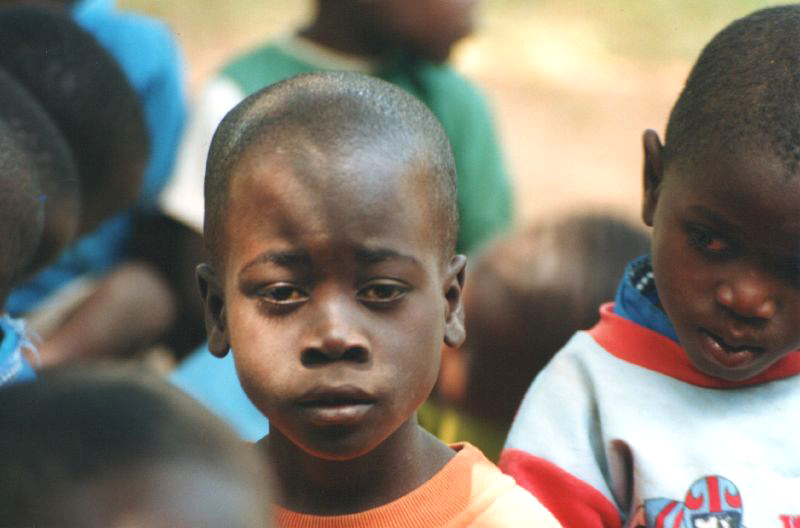
Staring me in the face was the tragic image of a Kenyan child condemned to the abject suffering of death by starvation. A massive tear confirmed the depth of his misery, yet his angelic eyes still beamed with the radiance of his life force. Not even the brutal assault of famine could extinguish the persistent flame of the human spirit.

In sharp contrast to the enduring blaze of his inner being, his corporeal shell had withered in a macabre synchronicity with the plants of his drought-ravaged environs. Yet despite his region's temporary scarcity of food, like his metaphorical counterpart, this diminutive scare-crow existed in a world glutted with comestibles that were not meant for him. With leather-like skin stretched tautly over his protruding skeleton, the slightest breeze would surely have caused him to rustle like a dry corn husk. Blood seeped from my heart as I made a vain attempt to imagine his pain.

Despite experiencing nearly overwhelming pathos, I remained focused and probed for a deeper understanding of this tiny innocent's torment.

Until recently, starvation had been an abstraction so far removed from my reality that I had hardly considered it. But in that one poignant moment, my years of personal struggles, work with the homeless over the last eight months, and choice to immerse myself in the human suffering encapsulated in that simple JPEG steeled my determination to examine, explore, and understand a grim aspect of human existence.

Starvation is a Grueling Process….

Denying the human body adequate nutrition for a prolonged period results in an agonizing three stage process of physical deterioration, a host of nasty symptoms, the potential of numerous excruciating afflictions, and eventually, death.

In the initial phase, the body breaks down stores of glycogen to produce the energy it needs. In less than 24 hours glycogen stores are generally exhausted and fats become the primary fuel for the body. Once fat is depleted, precious proteins comprising human muscle are metabolized to produce energy. This third stage causes rapid muscle deterioration and eventually results in the extreme emaciation embodied by the starving Kenyan boy whose image was now deeply tattooed onto my cerebrum.

A starving person can look forward to listlessness, fatigue, skin rashes, extreme irritability, and a significantly compromised immune system. Add diarrhea, scurvy, severe edema (swelling) of the abdomen, and heart failure to the mix and you have a comprehensive recipe for human anguish. Perhaps it is a blessing that most sufferers fall victim to illness or disease before starvation runs its course.

Famine and the Grim Reaper….a match made in Hell….

Delving further, I was startled to learn how widespread hunger and famine are on our planet, particularly in the "developing world".

Mark Elsis offered this sobering perspective at Lovearth.net :

"On Tuesday September 11, 2001, at least 35,615 of our brother and sisters died from the worst possible death, starvation. Somewhere around 85% of these starvation deaths occur in children 5 years of age or younger. Why are we letting at least 30,273 of the most beautiful children die the worst possible death everyday? Every 2.43 seconds another one of our fellow brothers and sisters dies of starvation. Starvation doesn't just happen on Tuesday September 11, 2001, it happens everyday, 365 days per year, 24 hours per day, it never stops."

On 12/5/06, the world human population was 6.4 billion. By that same day, 10.1 million people had starved to death in 2006. A human being dies from hunger-related causes every 2.43 seconds. Yet it doesn't have to be that way.

If all else fails, blame the victim…

Blaming starvation's victims for populating the planet beyond its capacity may assuage many people's guilt, but this heartless conclusion is based on pernicious myths. Humanity produces more than enough food to sustain the entire world population. The United States alone wastes a shocking 96 billion pounds of food each year even as we experience an epidemic of obesity.

In its rush to dominate, plunder and exploit "developing nations, the "developed world" (led by the United States), causes many of the famines it duplicitously attributes to irresponsible procreation.

"Free trade", "economic development", and IMF/World Bank "assistance" are prescriptions for disaster for the people of the "developing world". Having eliminated much of their own arable land for commercial or industrial use, the Neocolonial masters rely heavily on imported food from their servant states, significantly reducing these already impoverished nations' ability to feed their own people. Urbanization in "developing countries" (fostered by Western economic development) draws large populations into cities where people no longer have the means to cultivate their own food. World Bank loans usually result in projects that benefit the overlords and create a sea of debt for their underlings.

In its bid to oppress the world, the United States often installs and supports authoritarian leaders who implement Neoliberal policies that foment conditions leading to famine and starvation for their own people. Until the recent democratic successes of indigenous populists in Latin America, governments refusing to align with the United States were often comprised of ruthless elites whom the people initially embraced as a welcome respite from (or alternative to) US-style oppression. Either scenario generally results in profound misery for the poor and bliss for the aristocracy.

Budgeting priorities….spending $99.50 to kill them and 50 cents to keep them alive...

Not only does the United States contribute heavily to the atrocity of widespread starvation. Its economic aid for famine relief that many American apologists trumpet is negligible relative to the money it spends to wage war and kill innocent human beings.

Consider this excerpt from my inspiration for this essay, Andrew S. Taylor's brilliant piece entitled Moral Mathematics in the Post-Enlightenment Era ( http://www.mendacitypress.com/12.2006Taylor.html):

"As of October 22, 2006 the total cost of the Iraq war is $336 billion. Let's do the math. Four years after Afghanistan, we had spent $1.62 billion helping the citizens of that nation to rebuild their infrastructure and secure their "freedom." Less than four years after invading Iraq, we have spent 207 times that amount to violate the rights of a society that wants us gone from their home.

Here's more:

'To date in FY 2006, the United States has committed more than $175 million for immediate life-saving interventions, targeting the most affected areas in the Horn of Africa with water and sanitation, health, nutrition, and food assistance.'

And:

'Congress has already appropriated about $850 million for aid to all of Sudan in 2005 and 2006, and the White House has requested another $880 million.'

Well goodness, that's almost more than we've given Afghanistan! It is almost 0.5% of the yearly budget in Iraq, where it seems we may have killed more than the 400,000 than have already starved to death in Darfur, and no doubt displaced a number comparable to the 2 million displaced there."

Directing my thoughts back to the tortured soul whose photograph had imbued me with a desire to dissect the subject of starvation, I wondered if by some miracle he had survived. Other questions rushed to mind. What was his name? How old was he? What was his favorite game? What did he like to eat, when he had food? What happened to his parents? If he died, then how or when?

Realizing I could do little more than conjecture or speculate, I directed my attention back to my feelings. My sadness for the boy had progressed into abhorrence of the elites, oligarchs, and plutocrats, both here and in the nations plagued by famines.

I also felt grateful that I had disciplined myself to pursue my thoughts and feelings elicited by that haunting image of a dying child.

And what conclusions had I drawn or reaffirmed?

1. Exercising empathy is both a balm for the soul and anathema to American Capitalism.

2. A significant portion of world hunger is intentionally perpetuated to ensure that a relative few can gluttonously self indulge.

3. Manipulation and subjugation via economic means are often the principal causes of famines and mass starvation.

4. Behind the United States' façade of benevolent superpowerdom lurks a craven pack of ruthless predators with the moral principles of Caligula.

5. And perhaps most importantly, my oft-expressed antipathy for many of the institutions, systems, policies, and actions of the American Empire is well-founded.

In the final analysis, the little wretch for whom I had grieved had not suffered in vain. He had starved so that the "people who matter" can revel in their opulence.

And on top of that, we have an Empire to run. Somebody has to make sacrifices. It might as well be "Third Worlders".

by Jason Miller

Source: ZNET

Also see: UNICEF's new report, 'Child Alert: Horn of Africa',

Update on UNICEF 'Child Alert: Horn of Africa' Appeal, The Current Motion To The Scottish Parliament.

The Red Balloon, directed by Albert Lamorisse

The Red Balloon is my favorite film, I first saw it when I was 8. It's a beautiful film, I hope you enjoy it.

The Red Balloon Part 1

The Red Balloon Part 2

The Red Balloon Part 3

The Red Balloon Part 4

Source: bloodydoisneau

The Red Balloon is not Just a Child’s Film

The film The Red Balloon, directed by Albert Lamorisse, is, on the surface, a short, pointless movie about a young boy and a red balloon he finds. It is, on a higher level, a metaphor for friendship and a barometer for the viewer’s imagination, and inspires thought. It is a story about a boy who finds a red balloon caught on the top of a street pole. He really likes his balloon, and carries it on his way to school. However, balloons are not allowed on the bus, so the boy must either abandon it or miss the bus. He opts to miss the bus, because who would want to abandon a friend to get to school on time? This causes him to be late to school, and since he obviously cannot bring the balloon into school, he gives it to the janitor to keep until he is out. The janitor gives it back at the end of the day, and the boy walks back home, only to find that his mom does not want the balloon in the house, and throws it out the window. Most balloons would fly up and be lost forever, but this was the boy’s friend. It stays hovering outside his apartment window until morning. Those are the events of just one day, and this film spans several.

The acting in The Red Balloon is superb. The film does not have any dialogue, only sound effects, and an occasional unintelligible shout, so the actors’ abilities are really put to the test. For a young child actor such as the boy in this film, it would have to be a great challenge, and he was up to it. He portrays the perfect innocent little boy, making it seem like the genuine article. He emits an innocence and naiveté that are typical of a boy his age, and the adults in the film also seem genuine.

Sound is very important in a movie such as The Red Balloon, where there is no dialogue. Lamorisse does a fantastic job of choosing appropriate music and sound. For example, when the boy first climbs up the light pole to get the balloon, a playful little tune that seems a little mischievous plays in the background, and for sound effects, a good example is when the boy is running from a group of schoolboys trying to steal his balloon; in this particular scene the footsteps are loud and sound ominous as they close in on the poor little boy and his balloon.

The story is great, because it shows a little measure of ourselves in it. If you’re young or young at heart, you can instantly understand how the boy feels about his balloon and why he makes the choice to let the balloon use the umbrella on his way home from school, rather than keep himself dry. If you’re an adult or a realist, it makes you feel that maybe you should let a little more imagination into your life.

Cinematography is one of the most important features of a film, in my opinion. It is synonymous with the readability of an article or book, in that it dictates both the flow of the piece and the overall impression. The cinematography in The Red Balloon manages to emit suspense and a sense of urgency during the action scenes. One particularly good example is when the boy stops near a train yard to look at a train far below. He has the balloon with him, and he is by a metal fence with particularly sharp ornamental points on top. Just as the balloon nears the points, a wisp of fog or smoke from below obscures it so the viewer is left wondering what happened to the balloon -- whether it popped or not.

Another example to illustrate the great cinematography is a shot where the camera is aimed straight down a narrow alley. This shot occurred during a chase where some cruel schoolboys are chasing the boy with the red balloon. The boy with the balloon pauses for a while and hears footsteps, and since there is no way to see which direction they are coming from, the suspense is transferred from the boy to the audience. When they suddenly come into view, the viewer feels suspense just as the boy does.

Overall, I would recommend The Red Balloon for all ages, not just children or not just adults, because it is a two-for-one movie deal, philosophy and entertainment, combined in a fantastic package.

Source: LargeSock's Writing

Saturday, December 23, 2006

Snapshots from School

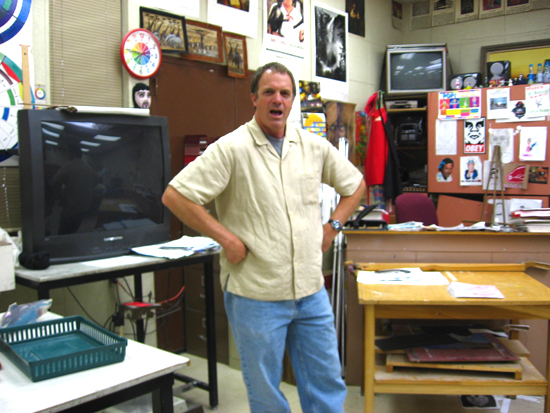
Mr. Clark is really angry
Source:Agaetisbyrjun's

You!!!
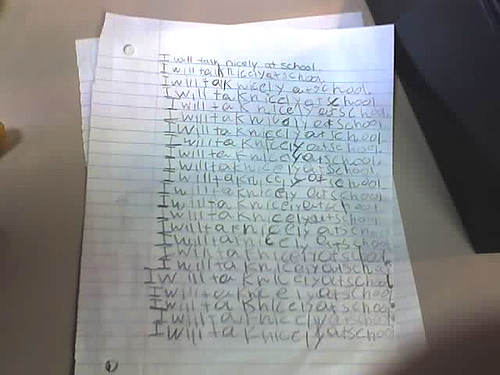
punishment


It's not my kid's paper... i just saw it on the desk outside the principal's office today!

A bunch of teachers were standing around giggling about it and asking each other which kid it was who had to do it.

School gossip!I like how the handwriting gets more and more angry-looking.

Source: Liz Henry

"Don?t go to the Parent-Teacher Council meeting," advised my daughter, who is a 9th-grader at a large urban high school. "They'll only try to scare you."

I shouldn't have been too surprised at how accurately she summed up at least one salient aspect of the culture at her school. After two days at the orientation for new students, she commented on the school's basic M.O., "I've figured out that they use fear a lot."

We wondered what she meant. Wasn't the school using the orientation as an opportunity to help the kids get to know each other, get acquainted with the school, and gain a measure of comfort before entering the big, scary secondary grades? No, apparently not. What were they doing?

"Well, they explained how we would get an F. And that if we got an F, we would get expelled. But if we got an F+, we could go to summer school to make it up."

The next day, they handed out candies to kids (keep in mind that these are 9th graders) who finished their math worksheets. And so the flip side of punishment made itself apparent, that is, reward.

I suppose it should not be too surprising that a traditional, inner-city school operating on low resources would have too much in its motivator tool box beyond the usual carrot and stick. The accepted mentality about learning, working, or doing just about anything besides watching TV is that it's a bitter pill that must be swallowed. The idea that kids (and adults) might find joy in learning or feel inherent gratification in their work seems to have been beaten out of us by a society that holds out consumption as the main source of satisfaction. A popular radio station in Boston plays music "to help your work day fly by." And that about sums it up. The workday and the school day are something that have to be tolerated, gotten through, survived.

My family has taken an unusual approach to schooling in the past (both of our kids have homeschooled for most of their lives), and so we are naïve in this new environment. This commentary is personal and anecdotal -- a reflection on schooling from a family that is new at it.

At back-to-school night, held soon after classes started, we learned something about the way fear and stress operate in schools. Not only were mundane stress-causing devices in place (the mis-firing bell ringing at arbitrary times, which teachers simply talk over; the public broadcasting system mistakenly airing some angry conversation; the limited time between classes -- three minutes in a school that is the size of a very large city block), but the teachers and administrators took every opportunity to raise the specter of failure.

The range of ways you could fail was enormous -- from failing to fill out the proper paperwork to failing to secure a scholarship. Inducing anxiety about the mundane along with the potentially life-changing results in pure anxiety about everything. It's hard to keep perspective about what matters and what doesn't. The school uses back-to-school night to ask parents to ally themselves with teachers against the child.

One guidance counselor, who acted like she was reporting from a subdivision of the police force, held up a piece of paper. "Do you see this?" she asked all the now (and formerly) petrified parents. "This is your paycheck." We stared back blankly. "This is the report card schedule. It will tell you how much you're getting paid. Your child's report card, you see, is the return you'll be getting on your investment. You've invested a lot in your children, and now it's pay-back time!"

She waved the report card schedule with a flourish while the parents waited obediently to try to make sense of what she was saying. I, for one, kept trying to reconcile everything-my-daughter-means-to-me with the idea that the flimsy letter grades that will some day be coming home on a flimsy piece of paper are somehow a form of compensation -- something she owes me.

Years ago, Paulo Freire criticized the banking model of education, whereby teachers treat students like a passive vault that holds knowledge. Teachers put the knowledge in and then get it back out in the form of tests or homework. But the guidance counselor on back-to-school night brought the banking model of education to a whole new level. "You'll be getting a good return on your investment," she said, "if your child brings home As and Bs. But if your child is bringing home Cs," and here, I swear, she wagged her finger at us, "you are not getting the paycheck you deserve."

I don't even believe in grades, and I'm not too fond of traditional schooling, but this lady was scaring me. All the ways I know my kid and feel confidence in her were getting crowded out by fear. People are judged by letter grades, after all, and what if hers aren't good? What if she doesn't get into college? What if she doesn't get a scholarship? What if she fails? What if we fail her by not instilling enough fear in her about her potential failure? What will we do? What will we do? When we got home, I asked to see her notebooks. "The teachers all say we're supposed to be checking your notebooks once a week to ensure you're not getting behind in anything."

She indicated her backpack loaded with binders and 10-pound textbooks. "Feel free," she said nonchalantly, but I could tell she was surprised. We had never checked her work before. We just trusted she was doing her best and would ask if she needed help. This system was working fine. It didn't feel good to change gears and perform this policing function. Nor did I relish the fact that in subsequent weeks, I was starting to ask, "So, how'd you do on that test? How's your grade in biology?" No wonder she didn't want me to go to the Parent-Teacher Council meeting. She could see I was not immune to their fear-inspiring tactics. After years of homeschooling and being outside of traditional, fear-based schooling, her armature against these tactics was perhaps in better condition than mine.

When you participate in an institution, you start traveling down the pathways that the institution offers you. You speak the language because otherwise you won't be understood. The institution of school prepares you for the institution of work and passive citizenship -- key ingredients to maintaining the current power structure. Fear limits your creativity; swinging back and forth between punishment and reward keeps you oriented toward external motivators; arbitrary authority acclimates you to subservience; severe boredom dulls your mind, lowers your expectations, and teaches you how to tolerate life rather than be an agent in it.

Many of the kids graduating from this school will end up in jobs -- either white-collar or blue, where they carry out orders. Perhaps a few will be in positions of power where they make important decisions and give orders. But all will have been trained to think that there is no other way it could be. They will learn, too, that the parameters of the institution allow for occasional random acts of kindness (the next generation's selfless teachers) at one end and extreme acts of evil at the other (the next generation's abusive cops). Systemic evils (war, profiteering, racism, sexism, etc.) will go largely unnoticed because they are the roads we walk, the language we speak, the walls we live inside of everyday. That's what schools teach: the parameters are set. You must operate within them. There's no point in contesting them. Get used to it.

When my daughter failed to note her section number in the designated spot on her art project, she received an F, and the teacher threw the piece away. I emailed the teacher, expressing respect for the challenges of having so many students, but also registering our concern about how demoralizing his tactics were. He did not write back, but he told Zoe the next day that he would give her partial credit for her work. "What does partial credit mean?" I found myself asking her?as if that is what mattered. It's not what matters, but there's no other way to engage with her teacher, and so you use the language that is best understood -- that of grades and credit, rather than what matters much more, i.e., creativity, expression, critical thinking, collective engagement, and effort.

And it's not the teacher's fault either. He has about 150 students -- Boston public high schools having a 31-student-per-class maximum. And he functions in the same overly stressed environment with insufficient resources. On the same day he slammed my kid with the F, he had been yelling at the class for wasting paint. Maybe he had hit the wall himself, dealing with the contradictions of being an art teacher in an overcrowded school with not enough money for paint and the asinine job of assigning grades to students' work.

Everyone, then, is required to function according to the norms of the institution. Teachers, too, deal with arbitrary authority (from administrators, state and city budget decisions, work rules, and standardized tests). Then they turn around and dish it out. More examples: Zoe's A in Latin got significantly reduced when the teacher discovered her binder was not properly organized. She almost got a zero on an English test because she had left one question blank. Why? Because she didn't understand the question. But then she heard the teacher announce that leaving any blanks would result in a zero, so she went back to her desk and made up something that she thought would fit. She received full credit, thus learning an important lesson in bullshitting.

Maybe it's not so bad to learn how to bullshit. And maybe we could all use some experience dealing with arbitrary authority and rigid institutional requirements. They are key survival skills. But as parents we should watch out for the ways we help do the school's dirty work. One parent I know got upset because her kid's biology teacher was not keeping up with the assigned pace for moving through the textbook. How would her child do on the mandatory citywide biology test at the end of the year if the teacher didn't keep up? What gets the parent's attention is the teacher's failure to stick to norms. But is anyone asking if the norms make sense?

I find myself feeling appalled at the content in her textbooks. And then I feel appalled that the schools are so underfunded that they don't have enough of them. How contradictory is that? "These textbooks suck, and you should get more of them."

How many other parents, are out there pushing schools to live up to their norms without questioning those norms in the first place?

How many parents are abiding by the terms set by the school system and agreeing to play enforcer at home?

The only teacher I really learned anything from in high school was my AP U.S. history teacher who never made it past the Rosenbergs. He got stuck there because it was a powerful moment in history and it really mattered. I remember how he challenged us to think and how I could tell that that mattered to him more than anything else did. Students were upset with him for failing to put them through their paces. Their AP scores would surely suffer. But I remember -- even at the time -- feeling grateful that he expected me to think. And to think hard.

There is pleasure in thinking hard and using your mind to solve problems you are interested in. That's what I want for my kid -- and for every kid. Not just for its liberatory aspects, but because the survival of the planet probably depends on it.

My daughter is no doubt getting something positive from her school. Many of her teachers genuinely care about the kids and their ability to learn. But the requirements of the institution include the fundamental lessons: Do what you're told. Don't ask why. Accept arbitrary punishment and reward. Reduce your expectations. Nobody said life was fair or fun. You can hold on until the weekend, the next holiday, graduation, a week's vacation from your job, and finally retirement. We all know what happens after that. You die. And the best you can hope for is that it all flew by, like the radio station promises?

By Cynthia Peters

Source:
ZNET

How Christmas Destroyed America


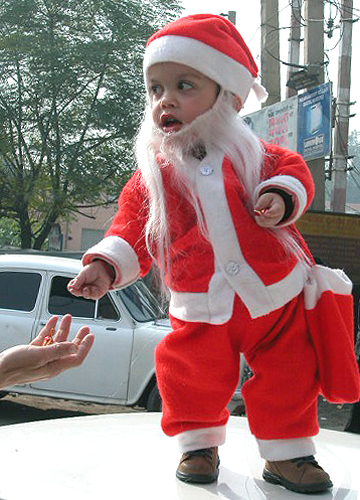
Sticker, Left seen near Great Western Road, Glasgow, Scotland


By Ed Howes

21 December, 2006

"He sees you when you're sleeping. He knows when you're awake. He knows when you've been bad or good, so be good for goodness sake."

The first god of most American children is a false god, more powerful than any to follow. When we are too young to understand much of anything about Jesus, a conspiracy of deception which includes parents, neighbors and media, promote a bearded fat man who has powers of God and judges children around the world.

The scam is not intended to last a lifetime, just long enough to teach a child no authority in his or her life is ever to be trusted. If those who love you will deceive you just because they think it is great fun, others will do so for no better reasons or for some perceived advantage. You might say a child lacks the sophistication to make such a connection. You would be as wrong as your parents and grandparents. All worthwhile relationships are founded upon trust. When those you admire, respect and model destroy that trust, they create a lifelong cynic.

We do not want to see the connection between Satan's Claws and a society indifferent to all which is done in their name. But the clear lesson of an American childhood is; one cannot trust anybody. Truth is relative. Believe what pleases you and ignore the rest. We go to school, not to learn what we need or want to learn, but what people who cannot be trusted want us to learn. Indeed, we learn much which was not intended, not least the many deceptions of other children, different from our own. When we are innocent and unsophisticated, some things we learn are overwhelming, but if we ask any adult authority about some troublesome matter we are ready to discount whatever they say because we know no one is to be trusted.

After we have had our illusion shattered by the truth about Satan's Claws and often before, we are introduced to yet another god of some sort. One which sees all we do and judges us. Fool me once, shame on you. Perhaps we have also been taught about an Easter Bunny, a Tooth Fairy and a Boogeyman, all with supernatural powers of one kind or another. Will the real god please stand up? Never mind, it is all make believe and illusory. We will eventually learn what really matters in America. To stop whining and do as we are told. The better we are at doing this the further we will go in life.

We learn when we are obedient we are rewarded and when we are disobedient we are punished. Truth is never relevant to any argument over proper and improper authority, since all are liars at the least and worse, bullies, thieves and murderers. And for all these types we must cope with, there are exceptions to the rule which validates their authority while excusing criminal behaviors. Politicians come immediately to mind. Tell you one thing and do another, just like mom and dad. So why should I care about anything I hear is going on? Chances are part or all of it is a lie to get me to do something stupid someone else wants to see me do.

If the President of the United States is playing Satan's Claws this year, bringing the gift of democracy to hundreds of millions, why of course he is and pigs fly. Other than the fact it is all being done in my name, why should I care? Is it my job to pull his sleigh? No, it is my job to be a good elf and pay the taxes that guarantee the credit he needs to play Satan's Claws. Hugo Chavez smells the sulphur and some of us elves are offended. How dare he?

So we are a material nation, spiritually retarded to the nth degree because our rewards are all material and our punishments material deprivations. Like our first romance, our first god never leaves us and most Americans will pass this most wonderful gift of betrayal to their own children who will later be encouraged to kill and die to bring Santa to the rest of the world. Let us boast to the world how great we are, doing all things in the name of God and country.

Source: Counter Currents.Org
Aslo see: Just another view Ed Howes website

Gaza's Reality - Video

Would you be able to live like this?

Friday, December 22, 2006

Is It For Freedom? Music Video


Created by Elisa Salasin for CodePink- music by Sara Thomsen

Happy Holiday's Music Video by Natural Childhood

Happy Holiday's Music Video by Natural Childhood

Music by Telepopmusik - Just Breathe. Images of children from around the world

Happy Holidays from Natural Childhood & Dyslexia Network

Thursday, December 21, 2006

MPs call for smacking ban citing human rights fears

by LAURA CLARCK
Last updated at 22:00pm on 26th November 2006

The children's tsar is spearheading a bid to ban parents from smacking on the grounds that it breaches human rights laws. Professor Sir Al Aynsley-Green is concerned that even the mildest of smacks infringes children's rights to dignity.

He is attempting to overturn current laws which allow gentle smacking as long as it doesn't leave a bruise or swelling.

In a separate initiative with the same aim, more than 170 MPs from across the political spectrum have signed a Commons motion calling for all smacking to be classed as assault.

A previous anti-smacking campaign in the run-up to 2004's Children's Act succeeded in securing curbs on parents which mean that hitting youngsters hard enough to leave a mark can result in jail terms of up to five years.

But Downing Street stopped short of supporting a complete ban on smacking, arguing that parents could end up before a judge for light slaps.

However the Prime Minister suffered a rebellion by 47 Labour MPs who wanted an outright ban.

More than 170 MPs from all parties have already signed an early day motion - used by MPs to draw attention to a controversial subject - which claims the UK is breaching human rights legislation in continuing to allow a "reasonable chastisement" defence.

Now Sir Al is calling for current laws to be repealed and is drawing up a dossier of evidence that they fail to protect vulnerable children from harm.

His campaign, backed by the Children's Commissioners in Wales, Scotland and Northern Ireland, will fuel the raging debate over corporal punishment and pile pressure on the Government to rethink the issue.

But critics see an outright smacking ban as an unwarranted intrusion into family life.

"There are many things parents do to and for their children every day that would be quite inappropriate, if not illegal, if they were to do them to anybody else" said Norman Wells, director of parent-support group The Family Education Trust.

Supporters of parents' rights to smack claim it can be a quick and effective form of discipline.

But Sir Al sees smacking as no different from common assault, which is a crime against adults but not children.

"Violence, including corporal punishment, is not acceptable," he said.

"The Children's Commissioner is now calling on the Government to repeal section 58 of the Children's Act 2004, which providers parents with an automatic defence to acts of common assault against their children.

"This is an essential step to bring about a much-needed shift in attitudes on the use of physical force against children and young people.

"Children and young people in England should have the same right to protection under the law on common assault as that afforded to adults.

"Treating children and young people differently under the law contravenes their rights to human dignity, physical integrity and equal treatment."

Northern Ireland's children tsar has mounted a High Court challenge to laws which state that parents can smack as long as their action does not leave a mark.

The laws are already in force in England and Wales but Barney McNeany is fighting their introduction in the province. Judges are due to decide the case early next year, in a ruling that could force the Government to change its position.

Tony Blair admitted in a TV interview earlier this year that he smacked his older three children but not Leo, his youngest.

Source: Daily Mail

Yemen imprisoning children despite ratifying child rights convention

Yemen, countryside west of Sana'a 1994. These brightly dressed young girls took time away from tending their goats for a photocall.

Hamzah Al-Madhabi, 17, was detained for three days in a capital city police station when he was 15 for stealing some potatoes and spent a further 18 months at the Sana’a juvenile center.

“Because the owner of the potatoes refused to forgive me, I lost hope. Although I confessed to my crime, the police tortured me by hitting and lashing me. Due to such harsh torture, I even had to confess to crimes I never committed,” he said.

According to Al-Madhabi, conditions at the police jail were dismal. “They offered us no food and the bathroom was in the worst condition,” he recounted.

Al-Madhabi is just one example of hundreds of children who have been detained illegally in a police station or juvenile center, whether for a minor crime or no crime at all.

“We receive complaints from families that their children are detained and tortured in prisons,” said Ahmed Arman, executive secretary of the National Organization for Defending Rights and Freedoms, known as HOOD.

Arman also raised the alarm about children who aren’t kept in juvenile centers but rather in prisons, where they “are brought together with adult criminals.” He added that they are often abused and mistreated.

“These children complain of malnutrition. The meals they get are neither well-cooked nor nutritious,” he said, “The prison officials are soldiers, who aren’t entitled to handle juveniles.”

Lawyer Jamal Al-Adimi blames Yemen’s judiciary system for such action. “It’s not allowed to imprison a juvenile for minor crimes, but police must do so to ensure that investigations can be conducted easily without having to search for suspect(s),” he explained.

The Yemeni government ratified the United Nations Convention on the Rights of the Child in 1991. According to international standards, any child under age 18 suspected or accused of committing a crime and found to violate the law can be placed in a detention center. However, the age limit is lower in Yemen at 15.

Arman noted that there is gross injustice in many cases involving imprisoned children. He cited extreme cases where police allow parents to send a son to prison as punishment for being disobedient or for committing a minor crime like stealing food or money or fighting with other children. Girls are punished at home. According to Arman, such acts run counter to the law.

In most cases, detention doesn’t exceed 24 hours. Judge Afrah Ba-Dowailan, head of the Sana’a Juvenile Court, noted that parents jailing their children is more a social phenomenon than a legal matter.

In some cases, even state officials can imprison children. Arman cited the example of Yahya Abu Saba’a, who since the age of 13 in 1997 has been detained at Sana’a Central Prison by Speaker of Parliament, Sheikh Abdullah Bin Hussein Al-Ahmar. Abu Saba’a did nothing, but his brother was accused of murder and disappeared.

There are nine juvenile centers throughout Yemen, two of which are for girls, but the Sana’a juvenile center receives the largest number of children. “We’ve received 500 boys since the beginning of 2006,” center head Mujahid Al-Zindani noted.

The other centers in Aden, Hodeidah, Taiz, Hadramout, Ibb and Hajjah governorates house some 400 children, of whom 40 are girls. “However, precise data on the number of children detained by law enforcement agencies is unavailable,” said Naseem Ur-Rehman, head of information and communications for the United Nations Children’s Fund in Yemen.

Such children, mostly under age 15, usually are accused of committing minor crimes, such as truancy, fighting with other children or using illegal substances like liquor.

Organized gangs sometimes exploit youngsters, particularly street children, and use them to smuggle goods, but very few are involved in violent crimes.

Prison conditions

According to Ur-Rehman, as in other developing countries, prison conditions are “dismal and harsh,” and most jails are crowded. “The worst thing is when children are kept with adults and forced to mix with criminals,” he added.

Even though the Yemeni government ratified the child rights convention, in reality, children who have violated the law are mistreated, often facing physical violence, lack of access to legal advice, basic food or entertainment in prison.

In an effort to reduce such practices, UNICEF is seeking to establish a system for juvenile justice in Yemen. In partnership with the government, it has recruited and trained juvenile lawyers to advise poor youngsters who get in trouble with the law. Ur-Rehman noted that 20 lawyers have been appointed to provide free legal advice in cases arising in the nine juvenile courts.

Additionally, UNICEF has assisted the ministries of interior, social affairs and justice, whereby 350 juvenile judges, police, social workers, law enforcement agencies and personnel working with children have been trained in getting “a better understanding of the rights of the child.”

Laws regarding child offenders

Ba-Dowailan stated that it’s against the law to keep a child under age 12 in police custody, except as a “precautionary measure” when the child is at risk of being abused or has nowhere else to go. However, she pointed out that there have been cases when some children exceeded the 24-hour period due to behavior by some officers.

Source: Yemen Times

Junk food ad crackdown 'flawed'

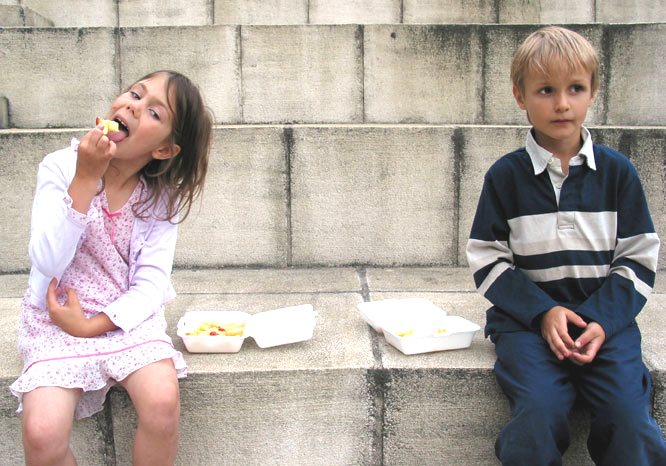
Above Girl and Boy with Chips

A crackdown on junk food advertising to children will not be effective as the programmes most watched by children will not be covered, campaigners say.

Ads for unhealthy food are to be banned from the end of March during TV shows targeted at under-16s, Ofcom has said.

But consumer group Which? said the plan was flawed after finding the 20 ITV1 programmes most watched by under 16s in October would not be affected.

Ofcom said its proposals had to be "targeted and proportionate".

Ads are to be banned during children's programmes, on children's channels and programmes watched by a higher than average number of children.

This is likely to cost broadcasters an estimated £39m in lost advertising revenue, according to the regulator.

The measures fall short of the pre 9pm blanket ban demanded by campaigners.

However, Ofcom still went further than expected. It had been initially considering a ban on junk food advertising during programmes aimed at under-nines, before increasing it to under 16s.

Despite this, the wording means TV favourites such as Coronation Street and the X Factor are not covered by the ban.

The research, carried out during a two-week period in October, showed that the most-watched programme that would face an junk food ad ban would be Spongebob Squarepants in 27th place which had 170,000 child viewers.

Children

More than 1.1m children watched Ant and Dec's Saturday Night Takeaway and over 800,000 tuned into Coronation Street.

More children even watched shows like Parkinson and ITV Evening News than Spongebob Squarepants.

Which? chief policy adviser Sue Davies said: "While Ofcom has recognised that its objective should be to protect children under 16, its proposed approach is completely flawed.

"Producers of foods high in fat, sugar and salt will still be free to advertise their products during the programmes most children are watching."

The Food and Drink Federation said it could not comment on the research, but said it still felt the proposals had gone too far.

A spokeswoman said: "We are currently consulting our members and will be submitting a formal response later."

An Ofcom spokesman said: "For every child watching the programmes listed there is typically nine adults.

"It would not be targeted or proportionate to impose a blanket ban before 9pm."

Source: BBC

Wednesday, December 20, 2006

Death from Ritalin

Story behind our Sons death caused from ADHD Drug, Ritalin.

Our fourteen-Year-old Son Matthew died on March 21, 2000. The cause was determined to be from the long-term (age 7-14) of using of Methylphenidate a medication commonly known as Ritalin.

Info for Parents who are pressured to diagnose and drug their children for ADD or ADHD. Story behind our Sons death caused from ADHD Drug, Ritalin.

Between 1990 and 2000 there were 186 deaths from methylphenidate reported to the FDA MedWatch program, a voluntary reporting scheme, the numbers of which represent no more than 10 to 20% of the actual incidence.

Source:
http://www.adhdfraud.org/commentary/1-6-02-2.htm

In 1998 at the National Institutes of Health Consensus on ADHD, the following statement was issued: "We do not have an independent, valid test for ADHD, and there is no data to indicate that ADHD is due to a brain malfunction".

Labels like ADHD, ADD, ODD, LD etc are in no sense true diseases. There are no reliable diagnostic methods. Psychiatrists cannot even agree among themselves about how to diagnose ADD/ ADHD. In addition, your child needs to, be put on a medication that is a close cousin to amphetamine because of the ADHD labeled.

IEP (Individualized Education Program)Parents if your Childs school wants to set up an IEP (Individualized Education Program) meeting, make sure you do your home work prier to the meeting; Know all your rights, you as the parent carry a lot of weight when it comes to making the decision for your Childs educational programs. Search Parents rights at IEP meetings.

See many of the
Conditions that Mimic ADHD

I want to warn parents of the risks involved in giving children psychotropic medications used to treat ADHD (Attention Deficit Hyperactivity Disorder). These behaviors are listed in the DSM-IV Diagnostic Criteria for ADHD.

Our fourteen-Year-old Son Matthew died on March 21, 2000. The cause was determined to be from the long-term (age 7-14) of using of Methylphenidate a medication commonly known as Ritalin.

Matthew took 10mg of Ritalin three times a day; he was taken away from us for one week for testing by the court. They said they would be doing organic testing. We found out this was never done. When he got home we were court ordered to give him 20mg three tines a day.

For the last year of his life he was taking 20mg of Ritalin three times a day.

The Certificate of Death under due to, (or because of) reads, Death caused from Long Term Use of Methylphenidate, (Ritalin). According to Dr. Ljuba Dragovic, The chief pathologist in Oakland County Michigan, upon autopsy, Matthew's heart showed clear signs of small vessel damage, the type caused by stimulant drugs like amphetamines.

The medical examiners told me that a full-grown man’s heart weighs about 350 grams and that Matthew's heart weight was about 402 grams.

Matthew did not have a preexisting heart disease or defect that we knew of. We, his parents never ignored his medical needs. The medical examiner said this type of heart damage is not easy to detect with the standard test necessary for prescription refills.

While visiting the doctor with the school’s diagnosis and the recommendation for Ritalin, he seemed very frustrated and asked us to let the school know, “I am not a pharmacy.” This leads me to believe that we were not the first parents sent to this doctor, with the schools diagnosis and recommendation for Ritalin.

No one ever informed us of other crucial tests (echo-cardiogram) that we could have had done that would have discovered the enlargement of the heart muscle, caused from scare tissue which these types of drugs cause. The standard test performed consists of blood work, listening to the heart, questions about school behaviors, sleeping and eating habits.

It all started for Matthew in the first grade the school social worker in Berkley, Michigan kept calling us in for meetings. One particular morning before an IEP meeting, the school social worker Monica Fuchs, my wife and I, were waiting on the others to arrive.

Monica made us feel very threatened when she said that if we wouldn't consider getting Matt on Ritalin for their diagnosis of Attention Deficit Hyperactivity Disorder, that Social Services (Child Protective Services) could charge us for neglecting his educational and emotional needs. My wife and I were scared of the possibility of losing our children, if we did not comply.

I believe that some school employees like having children medicated because, it makes frustrated students that are having a difficult time learning and understanding, easier to manage, regardless of the physical and psychological risks this practice poses to children.

Not all families can afford hundreds of dollars for a drug free, private evaluation, so they will not be cornered into medicating their child. I am hoping that Republicans and Democrats will work together and fight this horrific war against the forced drugging of our children.

Medical diagnosis should remain outside the realm of education and stay there. Pressure to seek specific medical treatment is not the job of the school system.

We did not want Matthew on any medications, even though the school social worker or the doctor never informed us about the dangers of Ritalin and other stimulant medications used for ADD and ADHD. We just didn't feel good about putting our son on drugs and we made it very clear to school officials.

“Informed Consent”, which states in part “A person’s agreement to allow something to happen [such as surgery] that is based on a full disclosure of the facts needed to make the decision intelligently; i.e. knowledge of risks involved, alternatives etc” and “the probable risks against the probable benefits.”

The violation of parent’s rights is when they are not told of the unscientific nature of so-called disorders such as ADHD or the risks of the treatments involving (drugs) and they certainly are not told of alternatives to their child’s behavior such as undiagnosed allergies or food sensitivities, which could manifest with the symptoms of what psychiatry calls ADHD.

If we weren’t pressured by the school system, Matt would still be alive today. I cannot go back and change things for us at this point. However, I hope to God my story and information will reach the hearts and minds, of many families, so they can make an educated decision with more than a little selective information, if any, paid for by psychology and drug companies.

I have created a website in hopes that parents will learn the health risks involved in using psychotropic medications on growing children.

I hope you will be spared all the suffering and heartbreak this whole ADHD issue has caused our family and many others.

Please do not be intimidated by family, school staff, doctors, or anyone into medicating your child for ADHD or ADD. These mental illnesses are scientifically unfounded with no scientific validity what so ever. The dopamine theory is nothing more than wishful thinking on the part of psychiatry and the pharmaceutical industry.

I truly believe this must have been my son’s purpose, to save the health and lives of many others.
How old will people live after taking these types of drugs as a child? Every time I hear about a child or young adult that has died from heart failure, I always wonder if they were ever on a psychotropic medication used for ADHD or depression.

If we would have known about all the children that have died from these psychiatric medications, I would have never given Matt the first pill.

Did you know that children that are diagnosed as having ADHD or ADD and take medication, the school labels them as learning disabled, and the schools receives additional state and federal funding per-child, per-semester.
I wonder if that is one of the reasons why school administrators are so adamant about medication, and the other would be to control their behavior, in their drug free school zone.

One of the hardest things for me to deal with is the fact that, Matthew never wanted his medication.

How many more 11-year-old Stephanie Hall's and 14-year-old Matthew Smith's will have to die before someone puts a stop to the biggest health care fraud ever? How many times will school psychology and drug companies get away with this?

In 1998 at the National Institutes of Health Consensus Conference on ADHD, the NIH issued the following statement regarding ADHD:

“We do not have an independent, valid test for ADHD, and there is no data to indicate that ADHD is due to a brain malfunction.”

Children, do not need to be made into little robots with medication. I feel that good parenting, structure, diets, and teaching methods can make all the difference in the world. Different children develop in different ways; you cannot put children all into one box.

Did you know that the ADHD diagnosis checklist of behaviors is almost the same as the list of behaviors for gifted children (visit The National Foundation for Gifted and Creative Children at
http://www.nfgcc.org

The DEA has classified Ritalin as a schedule two drug, comparable to Cocaine. Ritalin is also one of the top ten abused prescription drugs on the streets today.

From the research that I have done on amphetamines, when they are used, all the veins and arteries constrict and get very small which makes it hard for the heart to pump blood throughout the body. The extra force it takes to circulate blood causes high blood pressure and damage to the heart.

There are many other drugs that are given to children for ADD and ADHD with different names.

Amphetamine-type drugs such as Adderall, Concreta, Metadate, Ritalin and Dexedrine also antidepressant type drugs, Selective Serotonin Reuptake Inhibitors (SSRI), such as Prozac, Zoloft, Paxil and Luvox and the new selective norepinephrine reuptake inhibitors like Strattera which can cause serious side effects.

These can include seizures, cardiac problems such as arrhythmias, hypertension, heart failure and even death. These drugs can also cause emotional symptoms such as psychosis, agitation, aggression, hostility, anxiety and hallucinations.

Parents can find complete information about the side-effects of each drug in the drug insert from the pharmacist or in the Physician's Desk Reference.

We are coming to a point in our history where children have been taking these drugs for some time. Now the information is starting to come out.


What is ADD / ADHD ?

Is it a disease? Or a Fraud?

And what is the cause of the recent increase of senseless violence in our schools?
Who benefits from labeling kids with ADD? (Let's "follow the money"...)

We'd like you to watch a video by Dr. Fred Baughman. He will give you some very controversial information in this video. But first: Who is Dr. Fred Baughman?


Fred A. Baughman Jr., MD has been an adult & child neurologist, in private practice, for 35 years. Making "disease" diagnoses (real diseases like epilepsy, brain tumor, multiple sclerosis, etc.) or "no disease" diagnoses daily (emotional, psychological, psychiatric), he has discovered and described real, bona fide diseases.

Labels like ADHD, ADD, ODD, LD etc are in no sense true diseases. There are no reliable diagnostic methods. Psychiatrists cannot even agree among themselves about how to diagnose ADD/ ADHD. And your child needs to be put on a medication that is a close cousin to amphetamine because it is labeled with ADHD? Watch the video's by clicking on the link Here:
Video Here

WARNING: Below is a video that is not for the faint of heart or stomach.

The second video: "Psychiatry In Your Schools" contains footage and expert opinions by doctors and authorities on the cause of violence in our schools, if you have a child in a public school you need to spend the 12 minutes to watch the video. After you have seen the video, please read this incensed article by the Deputy Editorial Features Editor of The Wall Street Journal.Psychiatry is in your childs School and its NOT in their best interest. Don't believe it?
Watch this video's below:
Psychiatry In Your Schools
In November 2003 Fox Newsmagazine ran the following, it's also not for the faint of heart or stomach:
FoxNews Magazine

Read more about all of this HERE and HEREAre YOU aware of this kind of abuse? Do you have questions? Comments? Email me at: adhdfraud at austin dot rr dot comReport Psychiatric Abuse HERE They can and WILL help you.

Source: RitalinDeath.com
Also see: Ritalin prescription fears raised
"Learning Disorder"? Just Say No!
Fix the diagnosis not the children
New antipsychotic drugs carry risks for children